


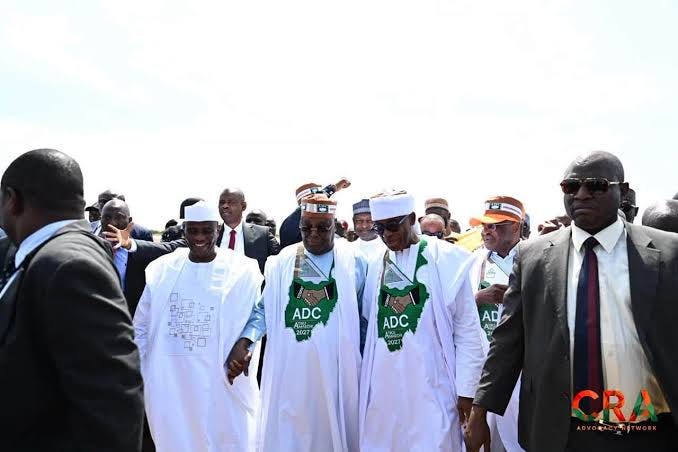
The Department of State Services (DSS) has rejected Atiku Abubakar’s claim that it recruited the protesters who disrupted an African Democratic Congress (ADC) rally in Sokoto State. The agency’s Director-General ordered an investigation into the allegation, which the ADC presidential candidate raised publicly.
DSS spokesman Favour Dozie issued the response on 3 November. He called the claim “surprising” and said it contradicted the agency’s record of protecting political actors across party lines. That defence rests on institutional reputation, not on evidence. The agency has not published the operational records that would settle the question either way.
The DSS supplied its own account of the Sokoto events. It said its operatives evacuated the ADC governorship candidate, Mannir Daniya, after a mob attacked him on 31 October. Daniya escaped unhurt. The same mob assaulted two DSS operatives, who remain in hospital.
The agency also addressed the attack on Omoyele Sowore in Ekiti State. It said police attributed the incident to an altercation and arrested 11 suspects. The DSS said it awaits the police investigation.
The two narratives cannot both be complete. Atiku’s account casts a federal agency as an instigator working to manufacture grounds for a curfew. The DSS account casts itself as a rescuer of the very candidate whose rally was disrupted. Both versions are consistent with parts of the record. Neither has been tested in public.
This mirrors the friction that has shadowed Nigerian security agencies in every election cycle since 2019, when the DSS detained opposition figures during the general election. The pattern is not that agencies always act politically. It is that they rarely publish enough for anyone outside the service to judge.
The strategic reading is straightforward. Atiku gains a grievance that mobilises his base and frames the 2027 contest as a fight against state capture. The DSS gains an opportunity to demonstrate even-handedness by producing findings that address the specific allegation. The ADC gains a platform, though not a remedy. The voting public gains nothing until the investigation concludes.
The investigation has no published timeline. Until it reports, the claim and the denial stand as competing assertions. The agency’s own account of rescuing an ADC candidate is verifiable. Its denial of recruitment is not. That asymmetry will shape how the dispute is remembered.
Winners and Losers
Winners: The DSS, which gains a platform to defend its record and an investigation it controls. Atiku Abubakar, who has placed the allegation on the public record ahead of the campaign.
Losers: The ADC, whose rally was disrupted and whose candidate was attacked. The two DSS operatives injured in Sokoto. Public confidence, which erodes each time an agency and a candidate trade accusations without published findings.
Bottom Line: An investigation is a process, not an answer. The test is whether its findings address Atiku’s specific allegation, not merely the agency’s general reputation.