


The Democratic Republic of Congo’s Ebola outbreak has become the world’s second-largest on record, with 3,532 confirmed cases and 1,556 deaths, according to government data. Health officials say the outbreak, caused by the rare Bundibugyo strain of the virus, is spreading faster than any previous Ebola epidemic and has no approved vaccine or treatment.
The World Health Organization has warned that the true number of infections could be up to four times higher than reported. Aid agencies say insecurity in eastern Congo, shortages of medical personnel and equipment, and community mistrust are hampering containment efforts. Africa CDC estimates that $1.4 billion is needed to control the outbreak, although current funding remains below target. The response has also been affected by U.S. travel restrictions, forcing some humanitarian organisations to reduce operations.
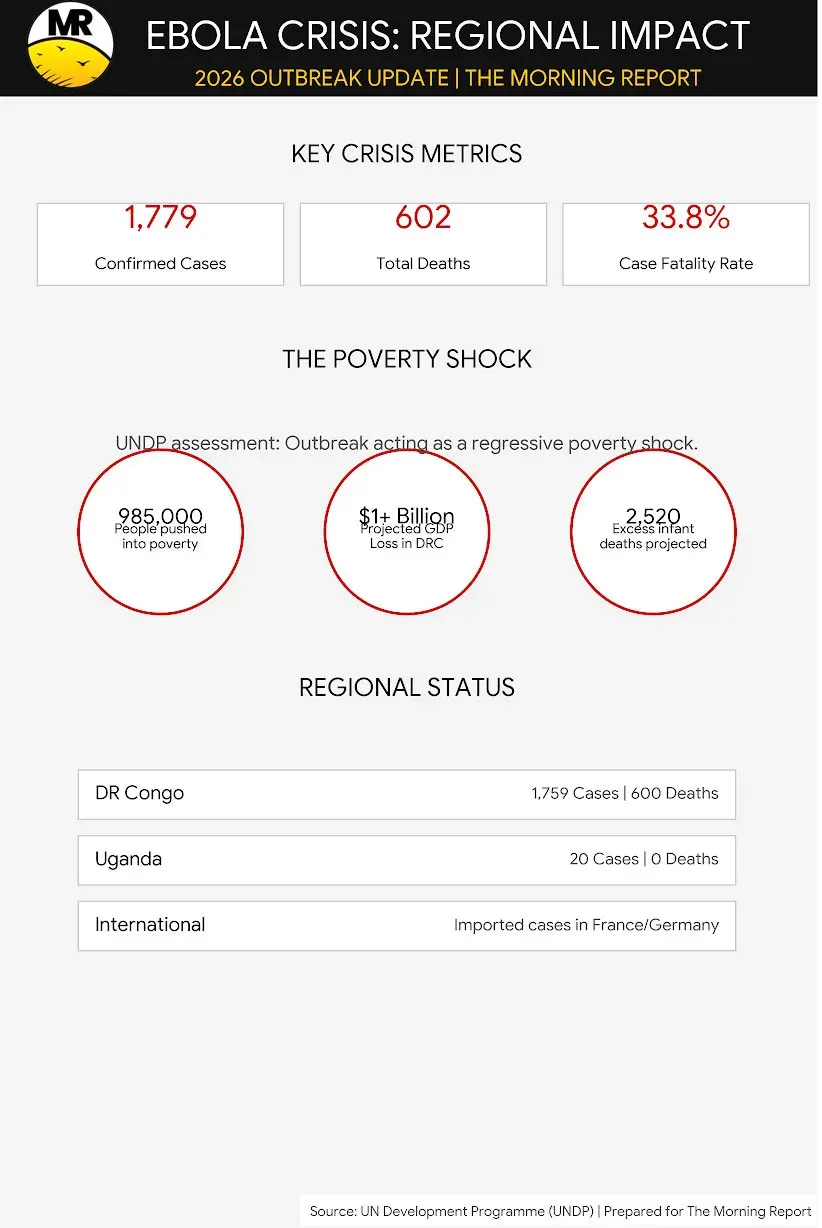
Only the 2014–2016 West African Ebola epidemic recorded more cases and deaths than the current outbreak. The rapid spread of the virus is deeply concerning, as the Bundibugyo strain has no approved vaccine or treatment. The shortage of medical personnel and equipment is a major challenge, as is community mistrust, which has led to some people refusing treatment or hiding infections.
The Nigerian stake is urgent. Nigeria’s public health surveillance systems are weak. The country’s borders are porous. The 2014 Ebola outbreak showed how quickly a virus can spread across West Africa. If the virus reaches Nigeria, the consequences could be severe.
From a Nigerian vantage point, the outbreak is a reminder that Nigeria is not immune to regional health threats. The country must strengthen its surveillance and preparedness systems before the virus reaches its borders. The funding gap for the response is also a concern, as it suggests that the international community is not doing enough to contain the outbreak.
This echoes the 2014 Ebola epidemic, when the virus spread from Guinea to Liberia, Sierra Leone and Nigeria. The outbreak claimed over 11,000 lives across West Africa before it was contained. Nigeria recorded 20 confirmed cases and eight deaths. The lesson was clear.
The winners: none. The losers: the 3,532 infected people and the 1,556 families who lost loved ones; and Nigeria, which has not yet learned the lessons of 2014.
Bottom Line: The DRC’s Ebola outbreak is now the second-largest on record. Nigeria is watching. The clock is ticking. The question is whether Nigeria is prepared.