


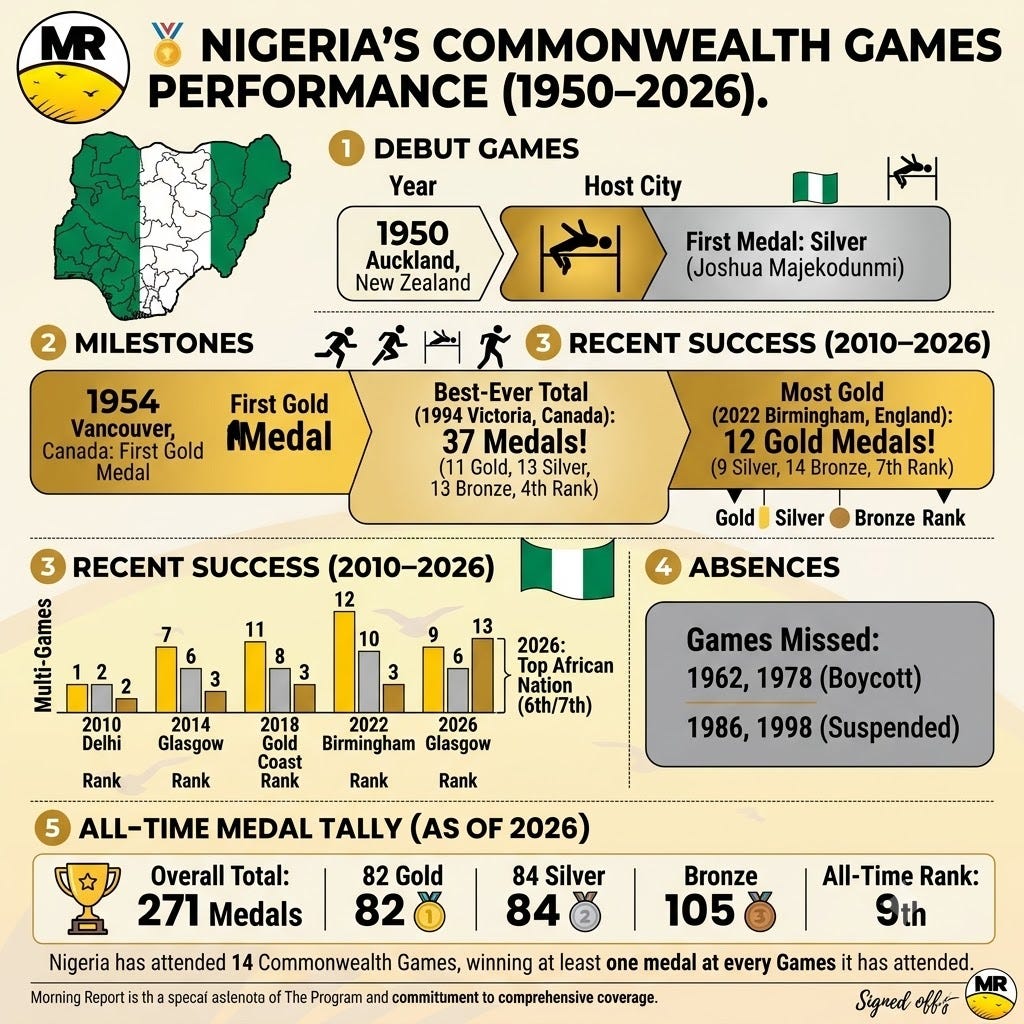
The glittering display of athletic prowess by Team Nigeria at the Glasgow 2026 Commonwealth Games has triggered a predictable wave of national self-congratulation. Returning home as the undisputed top-ranked African nation on the athletics medal table, Nigeria secured an impressive haul across the 100-metre sprints, the 400-metre flat, the 400-metre hurdles, and several technical field events. For a nation starved of positive global headlines, the performance felt like a long-overdue vindication of raw human potential. Official state communications were quick to frame the haul as the country’s most successful showing in two decades, positioning it as an undeniable structural turning point for domestic sports development. However, a cold, analytical examination of Nigeria’s athletic history reveals that brilliant tournament outings are rarely the result of functional domestic systems. More often than not, they are temporary triumphs achieved in spite of deeply broken administrative pipelines.
The official narrative coming out of the sports bureaucracy is expectedly celebratory, claiming full credit for the medal haul. Speaking during a media briefing in Abuja on 1 August 2026, the Chairman of the National Sports Commission, Shehu Dikko, declared that the Glasgow outcomes were the direct product of intentional policy shifts and early preparation camps. Dikko asserted that the commission had effectively dismantled the historic bottlenecks surrounding athlete allowances, equipment procurement, and elite coaching access. He argued that the strategic focus on technical field events alongside traditional short sprints marked a deliberate diversification of Nigeria’s sporting portfolio. According to the leadership of the commission, the success in Glasgow provides a battle-tested blueprint that will guarantee sustained podium finishes at the upcoming Olympic and World Championship cycles.
However, veteran sports scientists and technical experts argue that attributing this success entirely to recent administrative reforms overlooks the technical mechanics of elite performance. Dr Ken Anugweje, the Director of the Centre for Sports Studies at the University of Port Harcourt, offered a far more measured breakdown during a sports symposium on 2 August 2026. He noted that while podium finishes in field events like the shot put, long jump, and triple jump signal technical maturity, these disciplines require highly specialised long-term biomechanical training that cannot be manufactured in a three-month pre-tournament camp. Anugweje emphasised that field events yield far more consistent medal returns over an athlete’s career compared to the high-volatility sprint finals. He warned that unless Nigeria invests heavily in state-of-the-art sports science laboratories and local coaching certifications, the technical edge displayed in Glasgow will evaporate as current athletes age out of competition.
The current euphoria closely mirrors the aftermath of the 2014 Commonwealth Games, which were also hosted in Glasgow. Twelve years ago, Nigerian athletes delivered a similarly dominant performance, sparking identical declarations of a new era in track and field. What followed, however, was a decade characterised by administrative infighting, missed doping testing windows, last-minute travel logistics chaos, and the systematic decay of grassroots infrastructure. Olympic gold medallist and athletics administrator Enefiok Udo-Obong addressed this historical cycle during a television appearance on 3 August 2026. He stated bluntly that Nigerian sports administration suffers from chronic institutional amnesia. Udo-Obong argued that a successful Games routinely serves as an administrative cover, allowing officials to declare victory, collect performance bonuses, and completely ignore the foundational work required to build collegiate and secondary school athletic pipelines. He warned that celebrating Glasgow as a structural turning point before fixing the primary school sports ecosystem is putting the cart before the horse.
A deeper look at the composition of Team Nigeria’s medal-winning cohort reveals a familiar structural dependency. An overwhelming majority of the podium finishers in the sprints and hurdles do not train within the domestic Nigerian system. Instead, they are products of the United States Collegiate Athletic Association system, which provides the elite facilities, medical coverage, scientific nutrition, and high-level competition that Nigerian universities completely lack. Deji Aliu, a former international sprinter and active track coach, highlighted this stark divide in an interview published on 31 July 2026. Aliu pointed out that local coaches in Lagos, Port Harcourt, and Enugu are currently working on dirt tracks, using dilapidated weight rooms, and earning poverty-level wages. He noted that until the domestic environment can nurture a home-grown athlete from the grassroots level to an international podium without relying on foreign university scholarships, talking about a domestic sports renaissance remains entirely disingenuous.
Furthermore, the operational realities faced by the athletes prior to the Games contrast sharply with the victorious rhetoric of the government. Chukwuebuka Enekwechi, a veteran field event medallist who represented Nigeria in Glasgow, shed light on the pre-tournament logistics during an interactive session with journalists on 30 July 2026. While praising his teammates for their sheer resilience and professional focus, Enekwechi noted that basic operational support, such as the timely disbursement of training grants and access to elite medical rehabilitation, still requires persistent public advocacy and administrative friction. He observed that athletes frequently have to fund their own travel to international qualification meets before being reimbursed months later by state authorities. His testimony underscores a recurring truth in Nigerian athletics: national pride and individual grit routinely step in to bridge the gap left by state inefficiency.
The fundamental crisis facing Nigerian athletics is not a shortage of world-class talent; the country possesses an almost inexhaustible reservoir of natural athletic potential across its six geopolitical zones. The true bottleneck is the complete absence of institutional continuity. The National Sports Commission operates in an environment governed by political cycles, where policy priorities shift wildly whenever leadership changes. Budgetary allocations for sports development are routinely delayed by the Ministry of Finance, forcing federation executives to execute emergency planning rather than structured four-year Olympic cycles. Moreover, corporate Nigeria remains deeply hesitant to commit long-term sponsorship capital to sports federations due to persistent concerns regarding transparency, audit trails, and corporate governance.
If the success of Glasgow 2026 is to be transformed from a temporary high into a permanent competitive advantage, the federal government must urgently shift its focus from event-based funding to institutional infrastructure. This requires establishing decentralised high-performance training centres across the geopolitical zones, integrating sports science into university curricula, and creating an independent, audited sports development fund insulated from political interference. Without these hard structural interventions, the podium triumphs in Glasgow will simply join the long list of isolated achievements in Nigerian sports history, a brilliant victory lap that ultimately leads nowhere.
Winners: The elite athletes whose individual sacrifices secured career-defining medals, and the foreign collegiate systems that continue to refine raw Nigerian talent into world-class competitors.
Losers: Home-based developmental coaches who remain starved of equipment and living wages, and the Nigerian sports public, who are being sold a temporary tournament triumph as a permanent structural revolution.
Bottom Line: Raw talent and overseas university systems can win medals at a single Commonwealth Games, but establishing a genuine track-and-field empire requires local infrastructure, consistent funding, and administrative competence that Nigeria has yet to build.