


The Debt Management Office has drastically slashed its third-quarter bond issuance by up to ₦800 billion. This sudden reduction signals a massive strategic pivot within Nigeria’s fixed-income market. The regulator is rapidly adapting to an environment defined by tight liquidity and falling yields. The revised calendar lowers the planned issuance to a maximum of ₦4.6 trillion. The original projection reached up to ₦5.1 trillion. This retreat heavily echoes the infamous 2016 yield surge. Back then, tight liquidity and severe fiscal pressures pushed bond yields to record highs. The central judgment remains entirely clear today. The government is heavily leaning on short-term debt, essentially kicking a massive fiscal can down the road.
This calculated move follows a significant drop in secondary market yields. Over the past three months, the benchmark 15.45% FGN JUN 2038 bond has experienced a steep decline. Its yield has fallen by more than 250 basis points. This drop reflects immense institutional demand for Nigerian government securities. Institutional buyers simply cannot get enough long-term sovereign debt right now. Pension funds and corporate asset managers are aggressively buying these longer-dated bonds. They desperately want to lock in highly attractive returns. They anticipate a significant monetary easing cycle in the near future. When interest rates eventually fall, these locked-in high yields will become incredibly valuable assets.
The revised third-quarter calendar fundamentally reshapes the borrowing landscape. The government has introduced a brand new 10-year benchmark bond. This new instrument is the FGN SEP 2036. The issuance cements the 15.45% FGN JUN 2038 as the anchor security for the entire quarter. Meanwhile, the previously dominant 22.60% FGN JAN 2035 has lost its premier status. The government relegated this high-yield bond to a mere supporting role. It will now only appear in the July and August market auctions. This specific reshuffling is highly intentional. The state wants to borrow money for shorter periods to avoid paying high interest for decades.
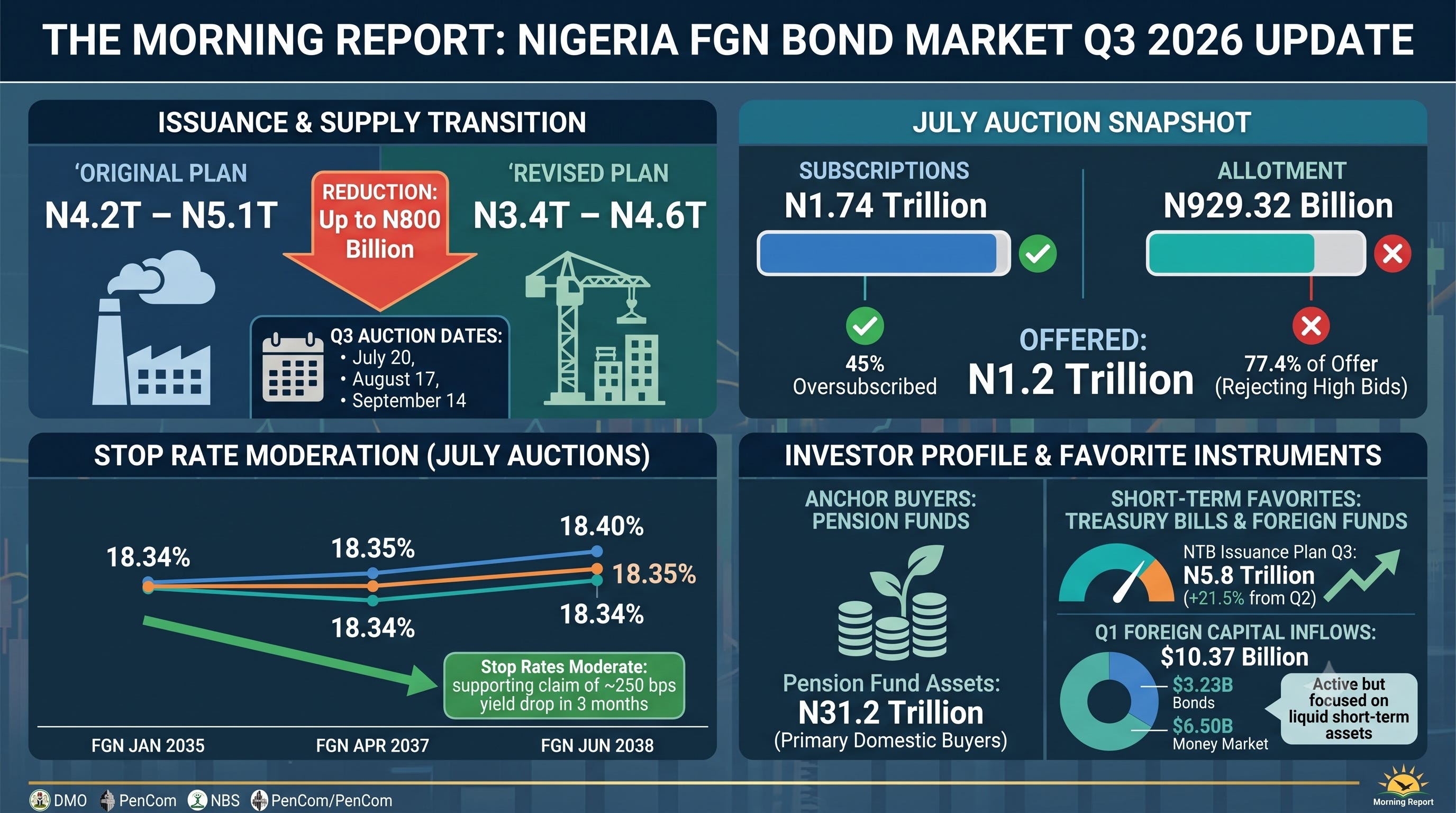
This strategy leans heavily into the Treasury Bills market. The DMO aggressively favoured short-term bills during the second quarter. They are now carrying that specific momentum into the third quarter by scaling back long-term bonds. Treasury Bills offer much shorter duration and lower interest rate risk for the buyer. They become incredibly attractive to conservative investors navigating a highly volatile macroeconomic environment. However, this strategy carries immense structural risks for the Nigerian state. Heavily relying on short-term debt guarantees severe refinancing pressures. The government must constantly roll over this debt every few months. This exposes the national budget to any sudden shift in investor sentiment.
Many market participants have openly welcomed this institutional responsiveness. Emeka Udo operates as a fixed-income trader at a prominent Lagos-based investment firm. Speaking during a market brief on 23 July 2026, he praised the reduction. He described the regulatory move as prudent and exceptionally well-timed. He noted that the fixed-income market is currently awash with liquidity. He argued that reducing supply will directly support healthy price discovery. He insisted this proactive supply cut will ultimately prevent a disorderly market sell-off. His perspective reflects the immediate relief felt by traders holding existing portfolios.
Institutional asset holders share this broadly positive outlook regarding the new issuance structure. Amina Bello works as a senior administrator for a large regional pension fund. She addressed an industry roundtable on 24 July 2026 to discuss portfolio strategies. She viewed the revised calendar as a net positive for institutional fund management. She maintained that the introduction of a new 10-year benchmark provides vital market depth. She explained that it gives pension funds a completely fresh instrument to anchor their portfolio duration. For administrators like her, clear benchmarks are essential for matching long-term pension liabilities with secure government assets.
However, neutral observers interpret the move simply as basic supply and demand mechanics. Sarah Mensah is a senior analyst at a prominent pan-African investment bank. She published a detailed client advisory note on 24 July 2026 regarding the calendar shift. She argued that the government is merely reading the room. She noted that the state is simply matching its supply with the prevailing market demand. She observed that the market is loudly telling the DMO that it prefers shorter-duration instruments. She concluded that the debt office is finally listening to its primary lenders.
Other analysts view this as a purely transitional phase for the domestic debt market. Femi Coker serves as the head of research at a Lagos asset management firm. He spoke at a corporate finance seminar on 21 July 2026 about market cycles. He observed that the deliberate reduction in bond issuance is an entirely temporary measure. He predicted that institutional buyer behaviour will shift aggressively soon. He projected that once the central bank begins its easing cycle, market dynamics will flip. He expects to see a massive pickup in demand for longer-dated bonds at that specific time.
Not all market watchers share this optimistic or neutral interpretation of the data. Dr Tayo Alabi is a lead economist at a respected Lagos-based economic think tank. Writing in a critical policy note on 25 July 2026, he offered a severe warning. He argued that the reduction in bond issuance actually masks a much darker market reality. He warned that this retreat could clearly signal rapidly weakening investor appetite for Nigerian debt. He suggested that the state may actually be reacting to significantly softer demand from foreign portfolio investors. He pointed out that these critical foreign investors have been net sellers of Nigerian bonds in recent months.
This pessimistic view focuses heavily on the persistent threat of domestic inflation. Chinedu Eze works as the chief investment officer at a boutique wealth management firm. He appeared on a morning broadcast on 22 July 2026 to discuss the risks. He warned that the market is currently pricing in a significant monetary easing cycle. He cautioned that this widespread optimism might be entirely premature. He argued that if domestic inflation remains sticky, the current market yields could reverse sharply. He warned that the government is taking a massive gamble on future macroeconomic stability.
The broader macroeconomic picture remains incredibly complex and highly contradictory. The Nigerian currency recently experienced a noticeable appreciation of ₦18 against the US dollar. This slight currency recovery has undoubtedly bolstered fragile investor confidence in the short term. However, severe structural concerns remain deeply embedded in the real economy. The national inflation rate is technically easing, but it stubbornly remains above 15 percent. This means the purchasing power of the average citizen continues to erode daily. A headline inflation rate above 15 percent makes any fixed-income investment inherently risky. The real return on these government bonds is often wiped out by the rising cost of basic goods.
External geopolitical factors are also actively threatening Nigeria’s fragile fiscal balancing act. Escalating tensions across the Middle East continue to pose severe upside risks to global energy prices. Any sudden spike in the cost of imported refined petroleum will immediately drive domestic inflation higher. Meanwhile, the central bank recently made a decisive policy choice to hold the Monetary Policy Rate. They kept the crucial lending rate locked firmly at 26.5 percent. This hawkish stance has provided some necessary short-term stability to the financial system. However, institutional investors and corporate borrowers are now watching the regulator’s next move with intense anxiety.
We must carefully humanise what these massive debt figures actually mean for the average citizen. When the government issues ₦4.6 trillion in domestic bonds, it is pulling capital out of the private sector. This is money that commercial banks will not lend to a local manufacturer in Aba or Kano. The state is essentially crowding out private enterprise to fund its own massive bureaucracy. Furthermore, relying heavily on high-yield Treasury Bills creates a brutal debt servicing burden. Every single naira spent paying high interest to wealthy bondholders is a naira stolen from public healthcare. It represents capital permanently diverted away from desperately needed rural road networks and basic municipal infrastructure.
Commercial banks are closely monitoring this strategic shift from the national debt office. These banks hold massive volumes of sovereign debt on their corporate balance sheets. When the government reduces the supply of lucrative long-term bonds, bank profitability is directly impacted. Commercial lenders rely on these high-yield government instruments to generate risk-free returns for their shareholders. By starving the market of the 22.60 percent bond, the state is forcing banks to seek returns elsewhere. Ideally, this should force commercial banks to actually lend money to private Nigerian businesses. In reality, risk-averse banks often prefer to simply park their capital in shorter-term Treasury Bills instead.
The historical comparison to the 2016 economic crisis provides a vital warning for current policymakers. During that previous period of severe economic stress, the federal government faced similar liquidity constraints. The state became trapped in a vicious cycle of rolling over short-term domestic debt at punishingly high interest rates. The underlying mechanisms of the current crisis are technically different from the 2016 currency collapse. However, the resulting macroeconomic trap looks remarkably identical to any observant market analyst. We are witnessing a government struggling violently to manage its financial obligations in a hostile economic environment. If global energy prices trigger another inflationary spike, this current strategy of relying on short-term debt will collapse entirely.
This revised calendar highlights the excruciating balancing act currently facing Nigeria’s sovereign debt managers. The federal government desperately needs continuous financing to plug its massive annual fiscal deficit. Simultaneously, it must aggressively manage the escalating cost of its domestic borrowing. It must do all this while maintaining the delicate confidence of hyper-vigilant institutional investors. The strategic reduction in long-term bond issuance is technically a step in the right direction. It shows a willingness to adapt to immediate market realities rather than forcing unwanted supply. However, the terrifying challenge of managing Nigeria’s exponentially mounting domestic debt stock remains entirely unresolved.
Winners: Institutional short-term traders and risk-averse commercial banks who easily profit from high-yield Treasury Bills in a highly liquid market environment. Losers: The Nigerian taxpayer who ultimately funds this expensive short-term debt cycle, and private sector manufacturers who are starved of commercial credit.
Bottom Line: A government that continuously kicks its fiscal obligations down the road using short-term debt will eventually face a devastating refinancing crisis.