


NAFDAC’s Investigation and Enforcement officers raided a store in Idumota, Lagos, and found assorted baby diapers, methylated balms, unregistered baby wipes and disposable pants. Some of the items, particularly the diapers and balms, had expired as far back as 2022 . The agency said in a post on its X handle that all offending products were evacuated and that investigations are ongoing to establish how they were stored and what was intended for them.
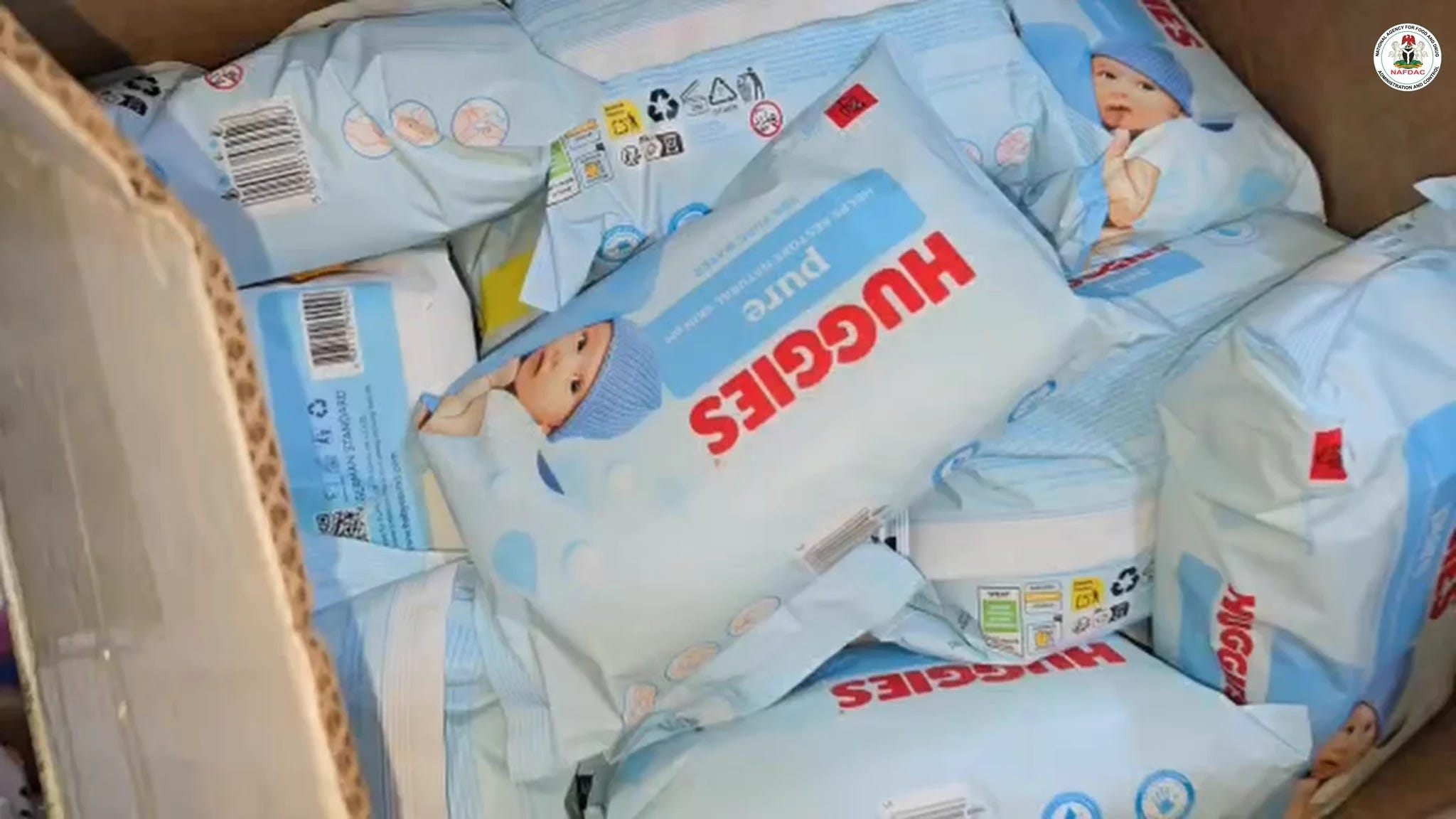
The mechanics of the discovery are less about the raid than about the gap it reveals. Idumota is one of Lagos’s densest commercial clusters, a distribution node that feeds smaller shops across the mainland and beyond. A product that sits in an Idumota store for four years is not forgotten. It is waiting. The question NAFDAC has not answered is who was holding it, who supplied it, and whether the same supplier is holding more.
This echoes the agency’s broader enforcement pattern in Lagos. In November alone, NAFDAC uncovered a warehouse at the Trade Fair Complex containing packaging materials for suspected falsified cosmetics and medicines . Between June 2025 and June 2026, it destroyed counterfeit and substandard products worth more than ₦1.5 trillion and secured 64 convictions, with 47,830 facilities under surveillance . The enforcement is real. So is the persistence of the problem.
The winners are NAFDAC’s enforcement directorate, which gets a visible seizure, and the parents who will not buy a diaper that expired when their child was an infant. The losers are the store operator, who faces investigation, and the consumers in markets beyond Idumota who will keep buying from suppliers whose stock nobody has inspected.
Bottom Line: A raid in Idumota removes one shelf. The supply chain behind it is still open.