


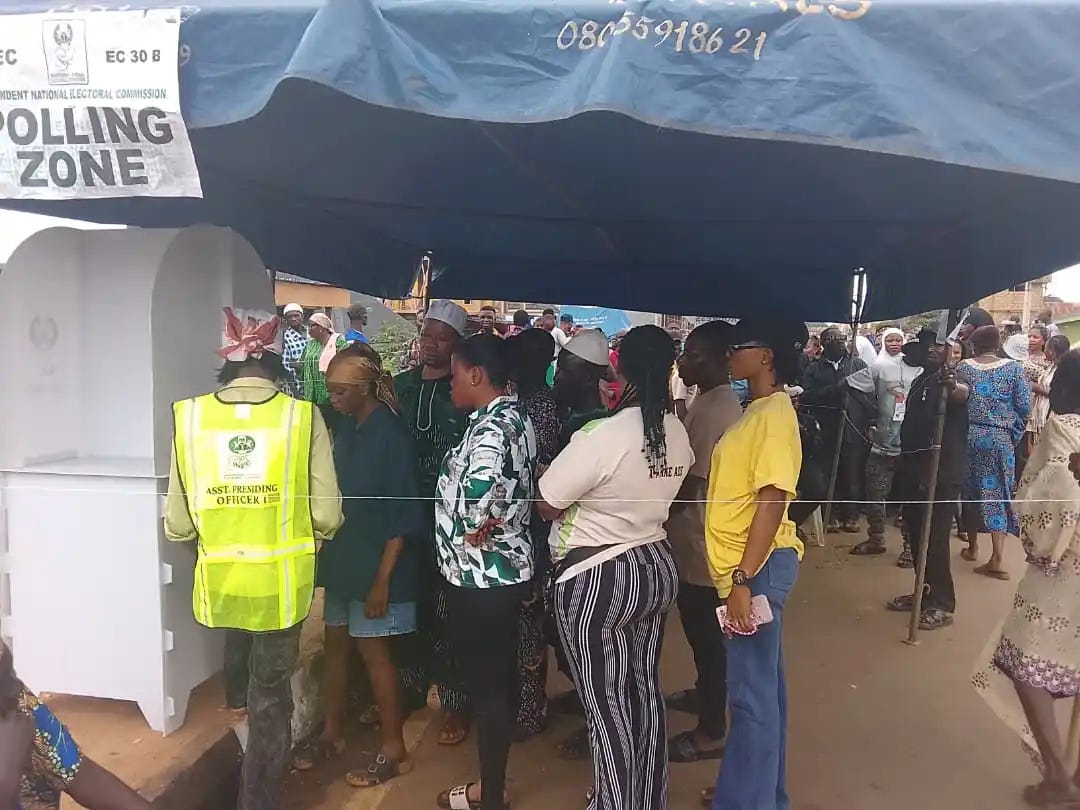
The Osun State governorship election was a day of stark contrasts. In some polling units, the process moved with clockwork precision; in others, it descended into chaos. As voters turned out in significant numbers across the state’s 30 local government areas, the Independent National Electoral Commission (INEC) reported that 94.5 percent of polling units had opened by 8:30 am. But beneath the surface of this orderly opening lay a day of violence, technical failures and relentless allegations of manipulation. By the time the sun set, Governor Ademola Adeleke had opened a narrow lead, but the final result remained uncertain.
The Shadow of Violence
The election was punctuated by reports of thuggery and intimidation that left voters fleeing for their lives. In Ejigbo Local Government Area, a notorious thug loyal to the All Progressives Congress (APC), identified only as “Big Hammer,” reportedly disrupted voting at the polling unit of the ADC governorship candidate, Najeem Salam. Videos showed voters and election agents scrambling in panic, with some forced to jump over fences to escape the attack. The incident was a stark reminder of the fragility of Nigeria’s electoral process.
In Ikire, the hometown of the APC candidate, Bola Oyebamiji, another APC chieftain, Mrs Funmi Hasstrup, was caught on video issuing a direct threat to voters. “Whoever doesn’t vote Ambo won’t leave the unit in freewill,” she said. “If you vote for anyone that is not Ambo, you will not go home”. The threat, captured on video and widely shared, added to the growing list of incidents that undermined the credibility of the poll. Governor Adeleke also raised the alarm about an alleged plot by the APC to bring a police officer from Port Harcourt to “disorganise the vote” in his hometown of Ede.
Technical Troubles and Systematic Concerns
The Bimodal Voter Accreditation System, intended to be the backbone of a credible election, became a source of frustration for many. In Osogbo, a BVAS machine at a polling unit in the Agowande Ward became unresponsive, leaving voters stranded in the queue. In Ila-Orangun, a single BVAS machine was reportedly available for more than 1,100 registered voters, leading to significant congestion. The Centre for Democracy and Development reported that the technical failures were one of the major operational challenges of the day.
The Nigeria Civil Society Situation Room expressed concern over the inadequate deployment of BVAS machines, prolonged waiting times and accessibility challenges for persons with disabilities. The group also reported incidents of vote-buying, harassment of observers, and the failure of ink pads in several polling units in Ilesa West Local Government Area.
The Alleged Plot
As results began to trickle in, the Adeleke campaign raised the alarm over an alleged plot by INEC to declare the election inconclusive. The Imole Campaign Council described the move as a “last-minute desperate move” by the APC to hijack its candidate’s victory. The campaign also reported the hijacking of ballot boxes at some polling units and called on security agencies to provide adequate protection at all collation centres.
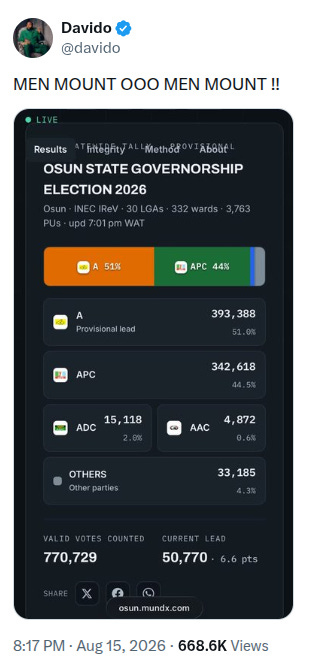
Davido: The Voice of Vigilance
Throughout the day, one figure loomed large over the electoral discourse: Davido. The Afrobeats superstar, who is also the nephew of Governor Adeleke, transformed his X (formerly Twitter) account into a command centre for the Accord Party’s election monitoring effort. His posts were a mix of raw emotion, strategic intelligence and relentless pressure on INEC.
His first major intervention came early, when he alleged that some Presiding Officers were planning to delay the entry of results until they reached the collation centres. “It is being reported that some POs are saying they will only input results at the collation center,” he wrote. “All Accord supporters and voters should ensure the results are filled into the form EC8A, signed, and uploaded to the iRev”. His warning to INEC was blunt: “Call your staff to orderrrrrrrrrr @inecnigeria. Federal might will fail here”.
As the day progressed, Davido’s tone grew more urgent. He posted that his team had 470 polling units covered and that “DELAY only means one thing: Buying time for Manipulation”. He demanded that INEC upload the results sheets to the IReV portal in less than 30 minutes.
He then turned his attention to specific political actors. “Hon. James Faleke, stop putting pressure on INEC to change Osun election result. Respect the wishes of Osun people. We don’t want Oyetola and AMBO,” he posted. He also alleged that Senate President Godswill Akpabio had called the collation centre to stop the process, writing, “Senator Akpabio has no Street authority to stop the coalition immediately it takes decision only at the senate Chambers. I just pray this thing works in favor of Adeleke”.
His final post of the day was perhaps the most succinct: “Osun will not allow another inconclusive. Senate president, Falake give up and allow the will of the people”.
The Numbers Game
By late evening, the Nigeria Elections Intelligence System showed that results from 303 of the state’s 332 wards had been collated. Adeleke had polled 177,572 votes, representing 50.5 percent, compared to Oyebamiji’s 158,588 votes, or 45.1 percent. The margin between the two leading candidates stood at 18,984 votes. Najeem Salaam of the ADC occupied the third position with 5,917 votes.
INEC had uploaded 2,339 polling unit results to its Result Viewing Portal, representing 60.22 percent of the expected total. The overall voter turnout was 42.8 percent, with 361,500 accredited voters out of 845,100 registered.
The final outcome remained uncertain. Adeleke’s lead was narrow, and the remaining results could still swing the election. But regardless of the final declaration, the day had already exposed the deep-seated challenges facing Nigeria’s electoral process.
The winners: the voters of Osun, who defied the threats and the technical failures to cast their ballots. The losers: the credibility of the electoral process, which was once again undermined by violence, intimidation and the perception of manipulation.
Bottom Line: Governor Adeleke leads early results, but the final outcome remains uncertain. The day was defined by thuggery, technical failures and Davido’s relentless social media campaign. The question is whether the final result will be accepted as a true reflection of the people’s will.