


Dangote Petroleum Refinery and Petrochemicals will begin trading on the Nigerian Exchange (NGX) on 1 December 2026, marking a major development for Nigeria’s capital market.
Devakumar Edwin, Vice-President of Oil and Gas at Dangote Group, announced the date on Wednesday, 25 November. He said the refinery would list following the completion of its initial public offering (IPO) process. The announcement followed the Securities and Exchange Commission’s (SEC) approval of the share-allocation plan.
The refinery initially offered 4.1 billion ordinary shares at ₦525 each, targeting approximately ₦2.15 trillion. However, investor demand exceeded the available shares, prompting the company to seek approval to increase the offer by up to 30 per cent.
The offer attracted approximately 3.78 million subscribers, who applied for about 11.15 billion shares. The approved allotment schedule provides for approximately 5.196 billion shares, valued at ₦2.73 trillion.
The offering was promoted as a people’s IPO, allowing Nigerians to acquire a stake in the refinery with a minimum subscription of 10 shares, costing ₦5,250. It was also made available through digital investment platforms to encourage participation by individual investors.
At the offer price of ₦525 per share, the refinery’s estimated market valuation stands at approximately ₦65.2 trillion, or about $47.8 billion. This could make it one of the most valuable companies on the Nigerian Exchange and significantly increase the exchange’s overall market capitalisation.
The listing will also change the refinery’s ownership structure. Aliko Dangote, who currently holds approximately 87.3 per cent, is expected to see his stake decline to about 84 per cent after the share allocation. This reduction reflects the introduction of additional shareholders rather than a loss of control over the business.
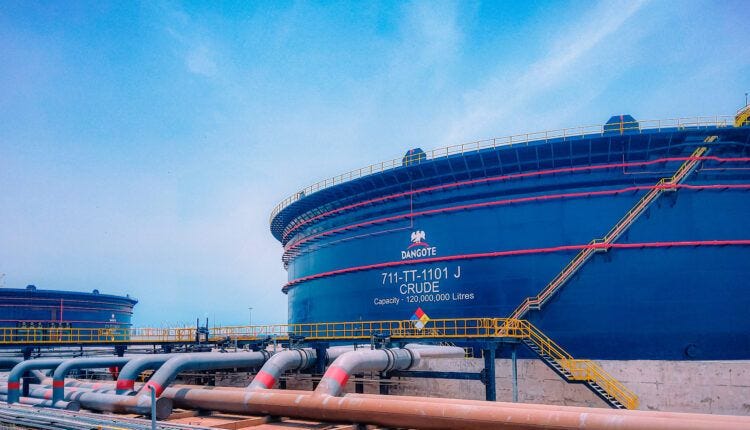
The refinery, located in the Lekki Free Trade Zone in Lagos, began operations in 2024. It has an installed processing capacity of 700,000 barrels per day and plans to expand this to 1.4 million barrels per day by 2029.
The expansion is expected to strengthen its position in the international petroleum market. The company also plans to use the capital raised through the public offer to support its wider growth ambitions.
The winners include successful subscribers, who will become shareholders, and the Nigerian Exchange, which stands to gain from a major new listing. Other investors could benefit if the company delivers sustained growth. However, retail shareholders will also carry the risk of price fluctuations, particularly if the refinery’s market performance falls short of expectations.
The listing could deepen Nigeria’s capital market by giving ordinary investors access to a major industrial company. But a high valuation does not automatically translate into profitability or returns for shareholders. Investors will need to assess the refinery’s financial performance, expansion costs, debt obligations and dividend policy.
Bottom Line: The December 1 listing opens the refinery to public ownership, but its long-term value will depend on financial performance rather than its impressive entry valuation.