


A Federal High Court has nullified the executive leadership council of the African Democratic Congress (ADC). Protesters aligned with former Vice President Atiku Abubakar assembled in the Federal Capital Territory after the judgment. The court’s decision removes the party’s current leadership structure. It also opens a fresh fight over who controls the ADC ahead of the next election cycle. Party leadership disputes are not new. The 2022 crisis in the Labour Party and the 2018 parallel congresses in the APC followed similar patterns.
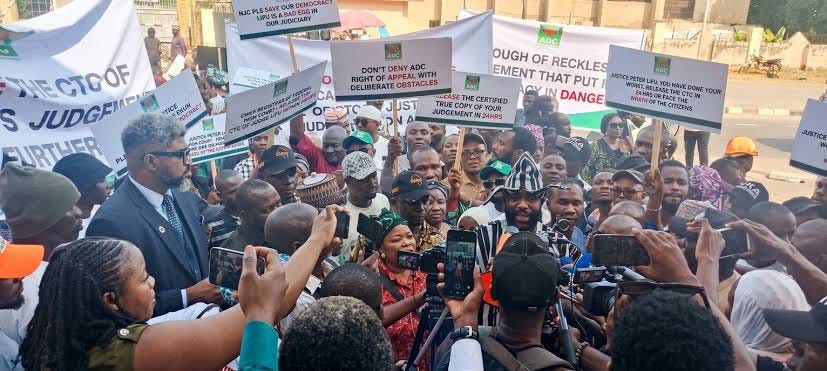
The mechanics are familiar. A court ruling creates a vacuum. Factions claim legitimacy. The Independent National Electoral Commission (INEC) must decide which faction to recognise. The protesters in Abuja have chosen the street as their court of appeal. That is a risky strategy. Street protests can signal grievance. They cannot appoint party officers. The court’s judgment, not the crowd, will shape INEC’s position.
The historical echo is the 2003 and 2007 election cycles, when party leadership disputes produced parallel candidates and legal battles. Those disputes weakened opposition coalitions. The ADC is not a major party. But its leadership matters to broader coalition talks. Atiku’s alignment with the protesters suggests that the former vice president is testing the waters for another political vehicle. If the ADC collapses into litigation, his options narrow.
The winners are the plaintiffs who secured the judgment and any faction that gains INEC recognition. The losers are the current ADC council, Atiku-aligned protesters who may gain sympathy but not power, and opposition coalition builders who need a stable platform.
Winners: Plaintiffs, any faction recognised by INEC, lawyers.Losers: The dissolved ADC council, Atiku-aligned protesters, opposition coalition builders.
Bottom Line: The court has reset the ADC. The real fight now moves to INEC, and the streets cannot make that decision.