


The Federal High Court in Abuja on Wednesday ordered the final forfeiture of about 48 properties linked to former Attorney General of the Federation and Minister of Justice, Abubakar Malami. Judge Joyce Abdulmalik granted the forfeiture application by the Economic and Financial Crimes Commission (EFCC), holding that Malami and others laying claim to the assets failed to prove that they lawfully acquired them.
Before delivering the substantive judgement, the judge dismissed several applications, motions on notice and objections filed by Malami, his family members and some companies claiming ownership of the properties. She held that the issue before the court was not “who owns the property, but how legitimate are the funds used to acquire the properties”. According to the judge, the respondents had “not dislodged the reasonable suspicion that the property was acquired by unlawful activities”.
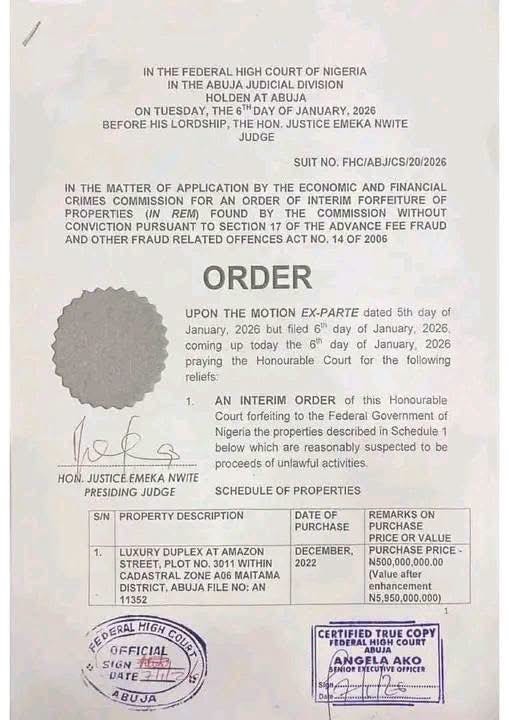
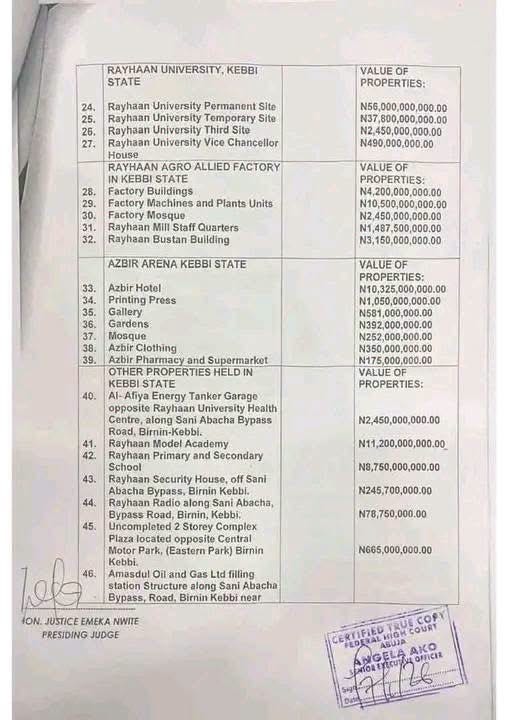
The EFCC had presented 57 properties linked to Malami for final forfeiture. The properties are located in Abuja, Kano, Kebbi and Kaduna states. The commission instituted the civil forfeiture proceedings in January, seeking the permanent forfeiture of 57 properties valued at ₦212.8 billion, which it alleged were proceeds of unlawful activities. On 16 January, vacation judge Emeka Nwite granted an interim forfeiture order over the properties.
Following the publication, Malami, his wife Nana Hadiza Malami, his son Abdulaziz Abubakar Malami, and several companies linked to the properties filed objections. They argued that the properties were lawfully acquired and that the EFCC failed to establish any connection between the assets and any unlawful activity. However, Judge Abdulmalik relied principally on Section 17 of the Advance Fee Fraud and Other Fraud Related Offences Act in granting the final forfeiture order.
Judge Abdulmalik vacated the interim forfeiture order in respect of some of the properties. The final forfeiture does not amount to criminal conviction or guilt of anyone, as Malami, his wife and son are jointly facing charges some of which involve illegitimate acquisition of funds with suspicious origins.
This is one of the most significant asset forfeiture cases in Nigeria’s history. A former Attorney General, the country’s chief law officer, is now linked to properties worth ₦212.8 billion. The case is a test of whether Nigeria’s anti-corruption institutions can hold powerful figures accountable.
This echoes the 2015 asset forfeiture case against former National Security Adviser Sambo Dasuki, which also involved significant assets and raised questions about the effectiveness of Nigeria’s anti-corruption efforts. The mechanism then was different, but the result was the same: a high-profile forfeiture that raised more questions than it answered.
The winners: the EFCC, which has secured a significant forfeiture; the Nigerian public, which may see justice served. The losers: Malami and his family, who have lost assets; and the Nigerian government, which had a chief law officer who is now linked to proceeds of crime.
Bottom Line: A court has forfeited 48 properties linked to Nigeria’s former chief law officer. That is a significant victory for the EFCC. The question is whether it is also a victory for justice.