


As dawn breaks across Osogbo this Friday morning, Osun State stands at a tense political crossroads. Months of bitter campaigning, explosive federal agency interventions, violent pre-election skirmishes, and global social media campaigns have built to a crescendo on the eve of tomorrow’s gubernatorial election. On Saturday, 15 August 2026, voters across the state’s thirty local government areas will head to the ballot box to determine whether to grant incumbent Governor Ademola Adeleke—running under the banner of the Accord Party—a second term, or return power to the All Progressives Congress (APC) under former NIWA Chief Executive Bola Oyebamiji, with strong third-party competition from candidates such as Najeem Salaam of the African Democratic Congress (ADC).
Yet, in the final hours before polling units open, the political narrative in Osun is defined less by economic blueprints and more by a high-stakes duel over state power, institutional neutrality, and security readiness.
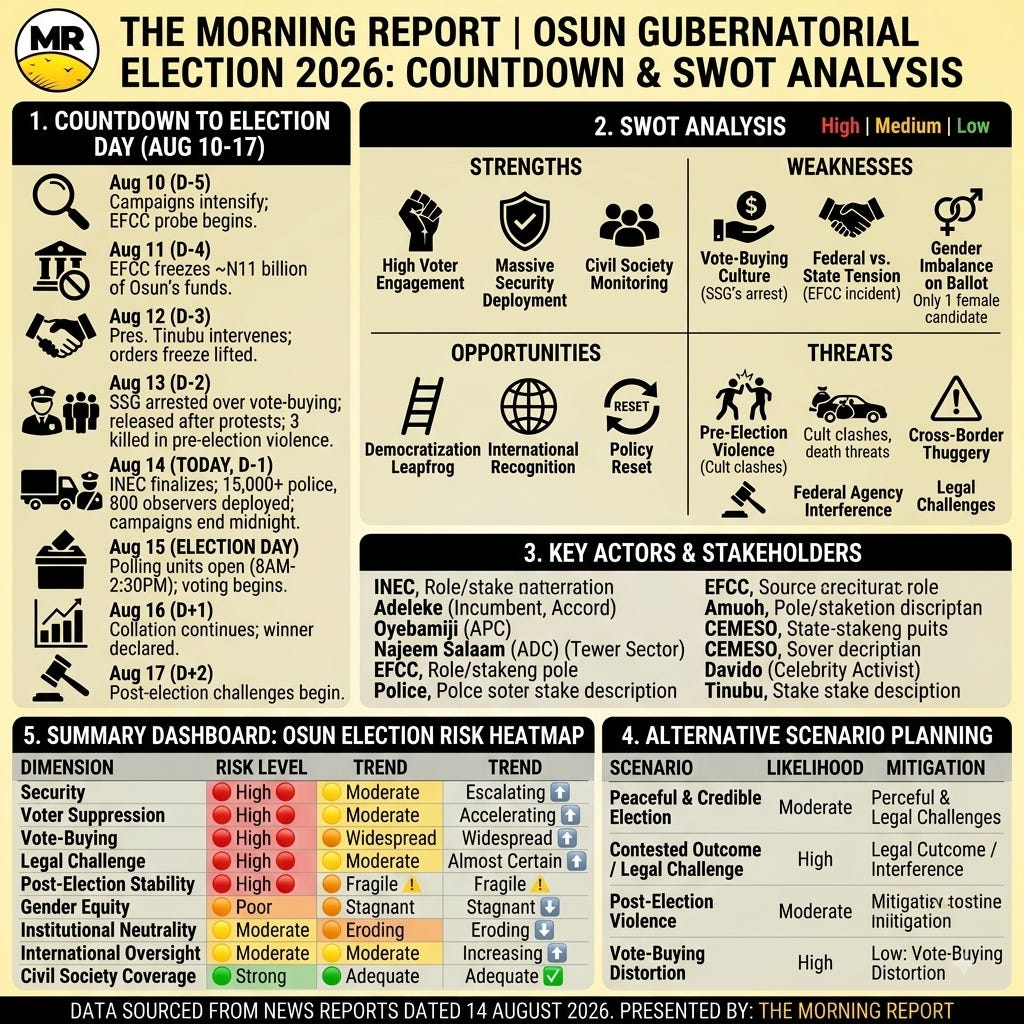
The political atmosphere reached a fever pitch earlier this week following a high-stakes standoff between the Osun State Government and the Economic and Financial Crimes Commission (EFCC). Tensions exploded when the anti-graft agency instructed commercial banks to place a Post No Debit order on Osun’s central operational accounts, freezing roughly ₦11 billion in state funds over an ongoing financial inquiry. Governor Adeleke immediately raised the alarm, characterising the sudden freeze as an orchestrated plot to paralyse state administration and starve his party of campaign logistics forty-eight hours before the poll. As the state government prepared emergency lawsuit filings, the House of Representatives Minority Caucus issued a scathing statement accusing President Bola Tinubu’s administration of weaponising federal apparatuses to skew the electoral playing field in favour of the opposition.
The financial standoff triggered severe backlash across civil society and federal legislative circles. Describing the escalation, Governor Adeleke’s spokesperson, Mallam Olawale Rasheed, denounced the move as an anti-democratic tactic born out of opposition fear, arguing that state institutions were being leveraged to subvert the popular will. Recognising the growing systemic risk and public outrage, President Tinubu intervened directly, ordering the EFCC to immediately lift the account freeze to preserve national stability and safeguard the integrity of the electoral process.
While the financial strangulation was averted, aggressive law enforcement operations continued to rock the state capital. Police operatives arrested Osun Secretary to the State Government, Teslim Igbalaye, over allegations regarding political cash distribution and vote-buying preparations. The detention of one of the state’s highest-ranking administrative figures sparked intense street protests in Osogbo, with state cabinet members accusing law enforcement of conducting a systematic campaign of intimidation. The arrest came shortly after a state commissioner was granted bail following days of police detention under similar circumstances. Under mounting public pressure and political friction, police authorities released the SSG, though state officials maintain that the arrests were calculated to destabilise campaign logistics on election eve.
Underpinning these political tremors is a volatile security situation that has kept both citizens and electoral observers on high alert. Pre-election violence flared in key urban hubs, where cult-related clashes claimed three lives, while a viral video showing a sitting senator issuing explicit death threats against political opponents prompted widespread public outrage and police investigations.
In response, the Inspector-General of Police restructured the state’s security leadership, deploying a new Commissioner of Police, Samuel Erale Etaifo, to assume direct operational command. Over 15,000 police personnel—comprising conventional officers, tactical squads, the Police Mobile Force, and specialised unit teams—have flooded Osun State to secure voting centres, border transit corridors, and critical infrastructure. The Independent National Electoral Commission (INEC) reaffirmed that the police force remains the lead agency for election security, reassuring the public that voting materials and personnel would be adequately safeguarded.
Civil society groups and election watchdogs have mounted extensive monitoring operations across the state to track voting security and institutional neutrality in real time. Timothy Bamidele of the Centre for Media and Society (CEMESO) announced the deployment of 800 trained observers across Osun’s three senatorial districts, highlighting that real-time monitoring and rapid incident verification will be vital to ensure that security forces remain strictly neutral and that voter suppression is documented immediately. Simultaneously, an election threat assessment released by Partners West Africa Nigeria (PWAN) warned that cross-border movements by political thugs and criminal groups across neighbouring Southwestern states pose a serious risk to voter turnout and public trust. The National Orientation Agency (NOA) echoed these concerns, issuing a stern warning that persistent political violence and cash-for-votes schemes threaten the fundamental bedrock of Nigerian democracy. Recent electoral research published by Dataphyte further underscored that while women dominate the voter register, they remain starkly underrepresented on the ballot, with only one female gubernatorial candidate clearing the final INEC roster.
The dramatic campaign has also drawn unexpected international focus, amplified by global pop star David Adeleke (Davido), nephew to the incumbent governor. Leveraging his massive global reach, Davido publicly tagged former U.S. President Donald Trump, international human rights organisations, and global election monitoring agencies on social media, urging international bodies to keep a close watch on Osun State to deter vote rigging or state interference.
Winners and Losers: In evaluating the political dynamics on the eve of the election, the clear winners in this turbulent period are the public servants and residents of Osun State, as well as advocacy groups dedicated to electoral integrity. The presidency’s direct intervention to rescind the EFCC account freeze prevented a structural shutdown of government logistics and emergency services, ensuring that public administration remains functional through the election weekend. Furthermore, democracy watchdogs gained critical leverage by mobilising 800 independent observers working in tandem with 15,000 security personnel, thereby establishing a comprehensive oversight mechanism to safeguard voting centres and deter voter suppression.
Conversely, democratic principles and public trust in key state institutions emerge as the primary losers leading into Saturday’s vote. Democratic norms suffered notable degradation due to deadly cult clashes, inflammatory death threats from legislative figures, and widespread allegations of state machinery being deployed for political advantage. Additionally, institutional credibility took a severe hit as both law enforcement and anti-graft agencies faced deep public scepticism regarding the suspicious timing of high-profile arrests and sudden account freezes in the immediate buildup to polling day.
Bottom Line: Ultimately, with federal account freezes revoked, state officials released on bail, and thousands of security officers lining the streets, the outcome of Saturday’s Osun election will depend on voter turnout, absolute security neutrality, and the transparent execution of the vote count across every polling unit in the state.