


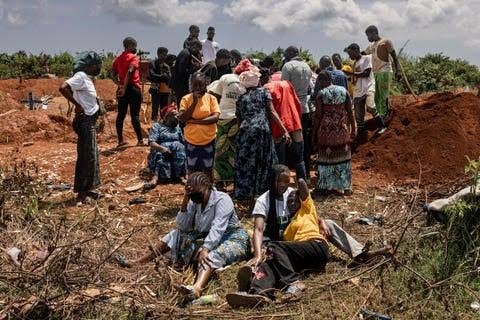
The Ebola outbreak in eastern Democratic Republic of Congo has infected more than 11,000 people and killed more than 5,500 since 15 May 2026. That makes it the second-largest outbreak recorded globally. Government data shows infections and deaths are rising at twice the pace recorded in the first six months of the 2014 to 2016 West African epidemic. The outbreak is caused by the rare Bundibugyo strain. It is Congo’s 17th outbreak and its largest to date.
The mechanics matter. The 2014 West African epidemic was slowed by contact tracing, community trust and rapid isolation. Congo’s outbreak is being slowed by none of those things. Insecurity and attacks on health workers have made parts of the east unreachable. Unpaid salaries have hollowed out the response teams. Coordination between national and provincial authorities is weak. The World Health Organization has warned that insecurity remains a major obstacle. Donors have pledged $2.9 billion, but less than half has been disbursed, according to the Africa CDC.
That funding gap is the detail that matters most. A pledge is a headline. A disbursement is a vaccine, a burial team, a contact tracer with a salary. The difference between the two is the difference between containment and exponential spread. Ebola spreads through contact with the sick and the dead. When response teams cannot reach a village, families perform burials themselves, and the virus moves with them.
This mirrors the 2014 outbreak in Guinea, Liberia and Sierra Leone, when early warnings were ignored and the response lagged by months. It also echoes the 2018 and 2019 outbreaks in North Kivu, when armed groups attacked treatment centres. The pattern is consistent. Congo’s outbreaks are driven not just by a virus but by a state that cannot secure its own territory.
The winners are the virus, which spreads unchecked; armed groups, which gain leverage by controlling access; and governments that pledge money without disbursing it. The losers are the 5,500 dead, their families, the health workers who face attack for doing their jobs, and the region. Eastern Congo borders Uganda, Rwanda and South Sudan. An outbreak that outruns the response does not respect borders. Nigeria’s own NCDC has opened border screening checkpoints. That is prudent. It is also a reminder that distance is no protection when the response fails.
Bottom Line: Pledging $2.9 billion and disbursing half of it is not a funding shortfall. It is a decision that 5,500 deaths were acceptable, and the next 5,500 will be too.