


TechCabal Insights tracked every African startup founded in 2016 through October 2026. The cohort raised about $1.89 billion. That is roughly 8.6% of the $22 billion that flowed into African startups since 2016. The money was heavily concentrated. Thirty-four companies account for $1.68 billion of the total. That is 89% of the cohort’s capital going to under a fifth of its members. More than 20 companies raised nothing.
The mid-2010s were a good moment to start a company in Africa. Mobile money was spreading. Smartphone prices were falling. Global funds were beginning to treat the continent as an asset class. Startups were founded across Nigeria, Kenya, South Africa, Egypt, Morocco, Uganda and Ghana. They spanned fintech, agritech, e-commerce, cleantech and health. Venture funds are built with a 10-year lifespan. A decade is the industry’s own yardstick. The cohort has had time to scale, sell, stall or stop.
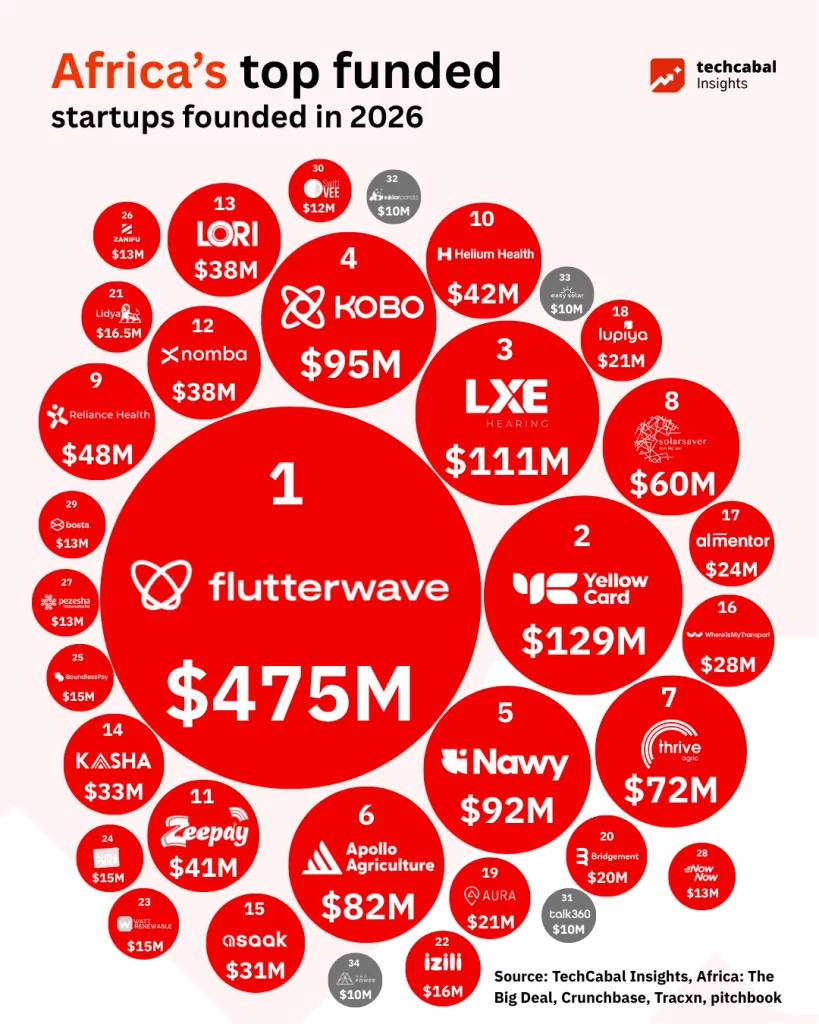
The median company raised about $1 million. The average, dragged by the top, was $9.45 million. Strip out the top 34, and the remaining 166 companies averaged $1.25 million each across ten years. For most startups, that finances a small team, a product that never gets the engineering it needs to scale, and a founder who spends much of the year raising money. Survival was the daily objective. Growth was a hope.
Flutterwave alone raised about $475 million. The 166 smallest companies raised roughly $210 million between them. One payments company from Lagos took in more than twice what two-thirds of its class managed in ten years combined.
Fintech took the largest share. Nigeria, Kenya, South Africa and Egypt took almost all of it. A founder in Kampala building for agriculture in 2016 competed for a different pool of capital. That pool was nearly empty.
Twenty-seven companies were acquired or merged between 2019 and October 2026. Twenty-one of those deals had undisclosed prices. Sellers publicise good numbers. A decade of silence on 21 transactions is a finding in itself. In a functioning market, winners exit, capital returns to funds, funds recycle it into the next cohort, and early employees become the next founders. The Class of 2016 generated very little of that.
Winners: Flutterwave and the top 34, which absorbed almost all capital. DocFox, which sold to nCino for $75 million. Global funds, which entered Africa as an asset class. Losers: The 166 companies that averaged $1.25 million. Founders outside Nigeria, Kenya, South Africa and Egypt. Early employees who did not become founders. The recycling mechanism that should fuel the next cohort. African venture capital, which remains concentrated and illiquid.
Bottom Line: A decade, $1.89 billion, almost no liquidity. The Class of 2016 tells the story of African venture capital. Capital concentrates. Exits are rare. The ecosystem needs recycling, not just fundraising. Until exits become common, the next cohort will inherit the same problem.