

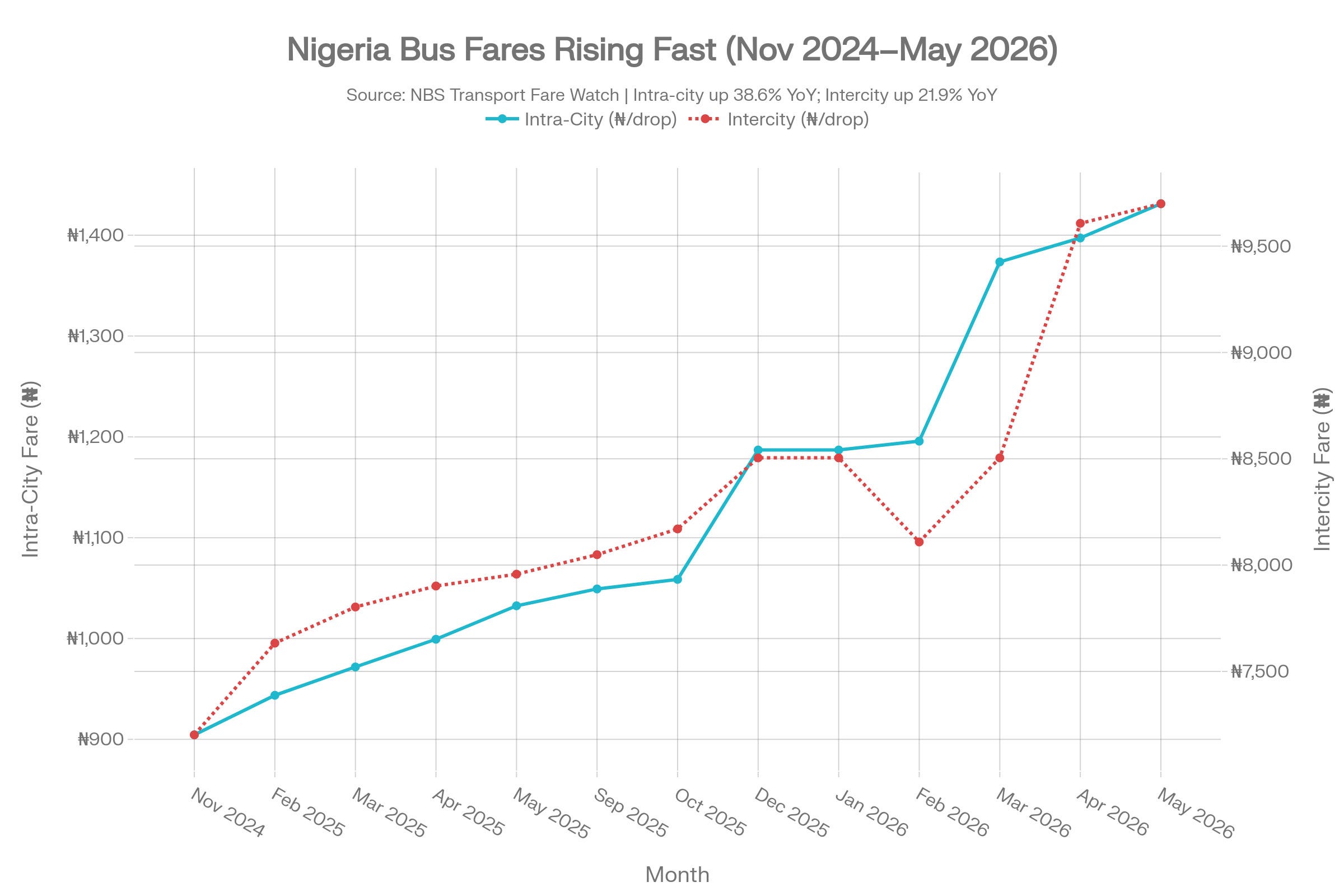
The average fare for bus journeys within Nigerian cities rose to ₦1,431.25 per trip in May, according to the National Bureau of Statistics. That is a 2.43% increase from ₦1,397.27 in April. On a year-on-year basis, the fare rose by 38.63% from ₦1,032.46 paid in May 2025.
The NBS said fares increased across major transport categories during the month, including intercity bus services, domestic air travel, motorcycle rides and water transport.
Motorcycle transportation recorded the sharpest annual increase. The average fare rose to ₦1,072.51, a 3.56% increase from April and a 52.45% rise from May 2025.
The average fare for intercity bus travel rose to ₦9,699.55 in May, a 0.96% increase from April and 21.89% higher than May 2025. Domestic airfare increased to ₦157,552.19, up 0.12% month-on-month and 20.86% higher than the ₦130,361.85 recorded in May last year. Water transport fares rose to ₦2,276.48 from ₦2,222.84 in April, a 2.41% increase.
The state-by-state variation tells a deeper story. Zamfara State recorded the highest average intra-city bus fare at ₦1,878.80, followed by Taraba State at ₦1,771.96. For intercity bus travel, Ondo State recorded the highest at ₦11,080, followed by Abia State at ₦11,066.13. Kano State recorded the highest domestic airfare at ₦184,139.29, ahead of Lagos State at ₦176,971.65.
For a minimum-wage earner in Zamfara, that ₦1,878 bus fare eats into a daily budget already strained by food inflation and electricity tariffs. For a family of five in Lagos taking two buses each way, the monthly transport bill now exceeds ₦30,000.
The winners: transport operators who are passing on higher fuel and maintenance costs. The losers: commuters, particularly low-income Nigerians in states with the highest fares, who are paying more to get to work and school.
Bottom Line: Transport costs are rising faster than wages. For millions of Nigerians, getting to work is becoming as expensive as the work itself.