


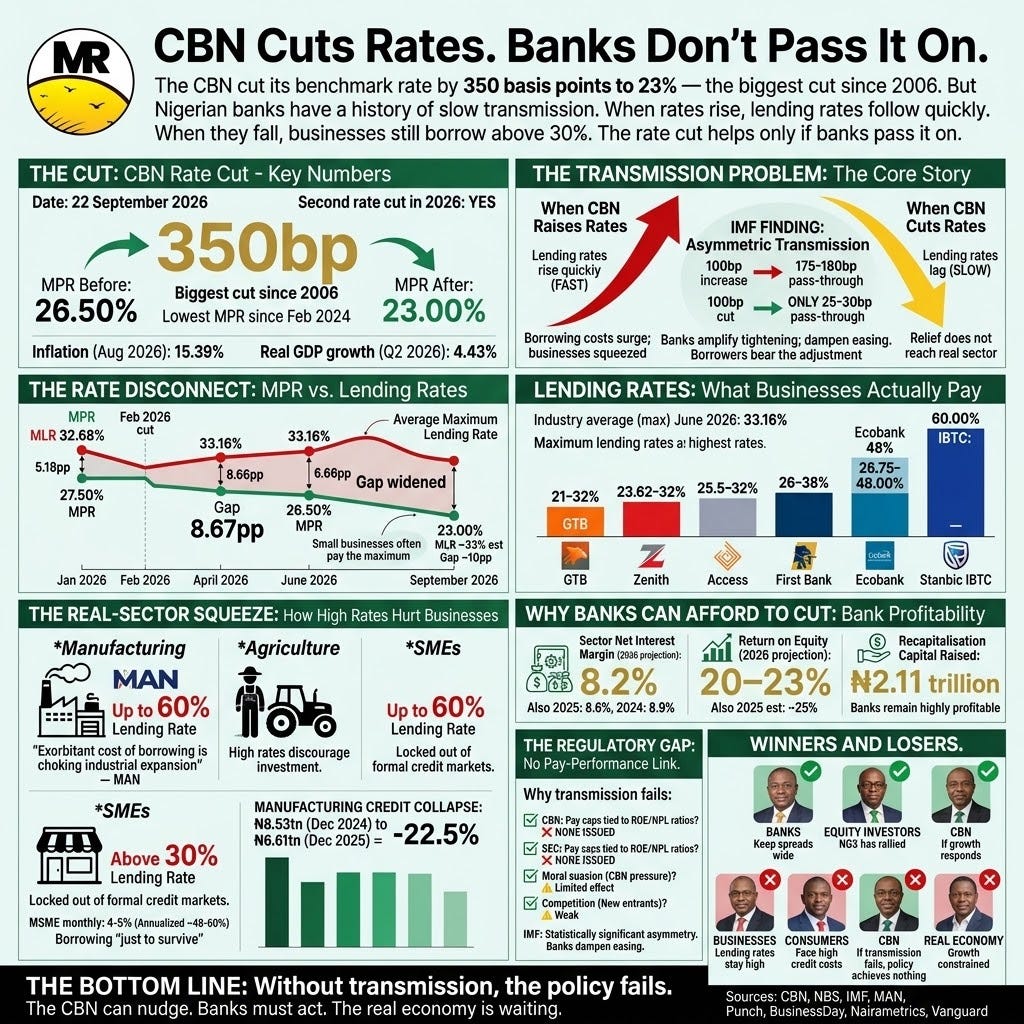
The Central Bank of Nigeria (CBN) has cut the Monetary Policy Rate (MPR) by 350 basis points. The benchmark rate now stands at 23%, down from 26.5%. The decision came at the 307th Monetary Policy Committee (MPC) meeting on 22 September 2026. It is the largest single rate cut in two decades. The CBN has pivoted from aggressive tightening to economic stimulation. Business owners across Ikeja, Aba and Kano welcomed the news. Then they remembered. A rate cut at the central bank rarely becomes a cheaper loan at the commercial bank counter.
The transmission problem
The gap between policy and practice is the core issue. When the CBN raises rates, commercial banks reprice loans upward almost immediately. When the CBN cuts, banks lag. They keep lending rates high to protect their net interest margins. In 2020, the CBN trimmed the MPR to 11.5%. Commercial lending rates stayed above 25%. Banks borrow cheaply from depositors and lend expensively to businesses. The spread fuels record profits. It starves the real economy of affordable capital.
The Lagos Chamber of Commerce and Industry (LCCI) and the Centre for the Promotion of Private Enterprise (CPPE) have demanded transmission. They say the policy will fail without it.
The CPPE’s position
Dr Muda Yusuf, CEO of the CPPE, called the cut a timely reset. He said it should reduce financing pressures on businesses. It should strengthen investment prospects. It should support growth. It should moderate the government’s domestic debt service burden. But he was clear. Deposit money banks must recalibrate their lending rates downward. Without that, the macroeconomic gains will not reach the real economy. Moral suasion has limits. Banks respond to regulation and competition, not appeals.
The manufacturers’ warning
Segun Ajayi-Kadir, Director-General of the Manufacturers Association of Nigeria (MAN), acknowledged the cut as positive. Then he delivered the blunt assessment. Even with the MPR at 23%, commercial banks will likely keep prime lending rates between 27% and 30%. Nigerian manufacturers borrow at 30%. Their competitors in Egypt, Morocco and South Africa borrow at far lower rates. No manufacturer anywhere can remain competitive or expand when borrowing at 30%. The rate cut alone does not close that gap. Transmission does. And transmission has not happened.
The CBN’s rationale
Governor Olayemi Cardoso explained the decision at the post-MPC briefing in Abuja. He said the reset was possible because of price stability. Inflation eased for consecutive months. Headline inflation dropped to 15.39% in August. Exchange rate convergence improved. External reserves reached $55 billion in September 2026. The CBN wants to align the benchmark rate with money-market conditions. It wants to provide a predictable environment for businesses and long-term investors. The easing is deliberate. The CBN believes inflation is contained. It believes the naira is stable. It believes the conditions are right for cheaper credit.
The banks’ defence
Commercial banks push back on the assumption that they will cut rates by 350 basis points. Analysts at Arthur Steven Asset Management said the cut is a double-edged sword. Lower asset yields will compress bank interest margins. Banks must balance credit repricing against declining profitability. They also face structural friction. The Cash Reserve Requirement (CRR) is locked at 45% for deposit money banks. Nearly half of their primary deposits are sterilised at zero interest. That keeps their effective cost of usable funds high. Banks argue this restricts their ability to slash lending rates aggressively.
Credit officers add another argument. High spreads reflect credit risk. Non-performing loans are rising. Energy costs are unpredictable. Infrastructure deficits persist. Lending to farmers, traders and manufacturers carries default risk. The wide spread between deposit and lending rates is a risk premium, not just profit-seeking. That argument has merit. It is also self-serving. Nigerian banks remain among the most profitable in Africa. Their margins are wide by regional standards. The question is whether the spread reflects real risk or market power.
The market surprise
Kasimu Kurfi, Managing Director of APT Securities and Funds Limited, noted that most analysts expected the CBN to hold rates steady. The 350-basis-point cut was a surprise. Kurfi said the unexpected cut creates an opportunity for corporate borrowers to negotiate better terms. But banks will take a cautious, phased approach to repricing their loan books. They will monitor liquidity and portfolio quality before making deep cuts. The phased approach means relief will be slow. For businesses struggling now, slow relief is no relief.
The historical parallel
This is not the first time Nigeria has faced this gap. In 2016, the CBN raised the MPR to 14% to defend the naira. Lending rates stayed above 25%. In 2020, the CBN cut to 11.5%. Lending rates stayed above 25%. The pattern is consistent. The CBN controls the benchmark. Banks control the spread. When the benchmark falls, the spread widens. The real sector pays the price. The difference now is the scale of the cut. A 350-basis-point reduction is larger than any in recent memory. It gives banks more room to cut. Whether they use that room depends on pressure from the CBN and competition in the market.
The winners
Equity investors on the Nigerian Exchange (NGX) are winners. Lower fixed-income yields will drive capital into stocks. The NGX has already rallied. Foreign investors have returned after the FTSE reclassification. The Dangote refinery IPO adds momentum. Corporate earnings for listed firms may improve if borrowing costs fall. The federal government is also a winner. Lower interest rates reduce the cost of servicing domestic debt. That frees fiscal space for infrastructure. The government spends a large share of revenue on debt service. A rate cut eases that burden. It also reduces the crowding-out effect on private credit.
The losers
If banks do not transmit the cut, the real sector loses. Small businesses will continue to face prohibitive credit terms. Farmers will borrow at 30% or not at all. Manufacturers will struggle to expand. Consumers will face high prices because production costs remain high. The CBN’s monetary stimulus will remain locked inside banking halls. The policy will fail. The CBN’s credibility will suffer. Businesses will lose faith in monetary policy as a tool for growth.
The structural constraint
The CRR is the elephant in the room. At 45%, it sterilises nearly half of bank deposits. Banks cannot lend what they do not have. The CBN uses the CRR to control money supply. It also limits lending capacity. If the CBN wants transmission, it must consider lowering the CRR. That would free up funds for lending. It would also increase money supply. The CBN must balance inflation control with growth support. The current framework favours control. Transmission requires a different balance.
The regulatory question
The CBN can pressure banks. It can issue directives. It can set targets. It can use moral suasion. But banks are profit-seeking institutions. They will cut lending rates when competition forces them or regulation requires it. Nigeria’s banking sector is concentrated. A few large banks dominate. Competition is limited. That gives banks pricing power. The CBN must decide whether to use that power. If it does not, the rate cut will benefit banks and the government. It will not benefit the real economy.
Winners: Equity investors, who gain from lower yields. The federal government, which saves on debt service. Banks, which keep spreads wide. Listed companies, which may see earnings improve. The NGX, which gains liquidity.
Losers: Small businesses, which face high lending rates. Manufacturers, who cannot compete regionally. Farmers, who cannot afford credit. Consumers, who face high prices. The CBN, if transmission fails. The real economy, which remains starved of affordable capital.
Bottom Line
The CBN delivered a powerful signal. It cut the MPR to 23%. It wants banks to lend more cheaply. Banks have not responded yet. They may not. The CRR is high. Competition is low. Risk premiums are real. The CBN can moralise. It can regulate. It cannot force banks to lend at a loss. Until the CRR falls or competition rises, the rate cut will stay in the banking halls. The factories, farms and shops will wait. The CBN has done its part. The banks must do theirs.