


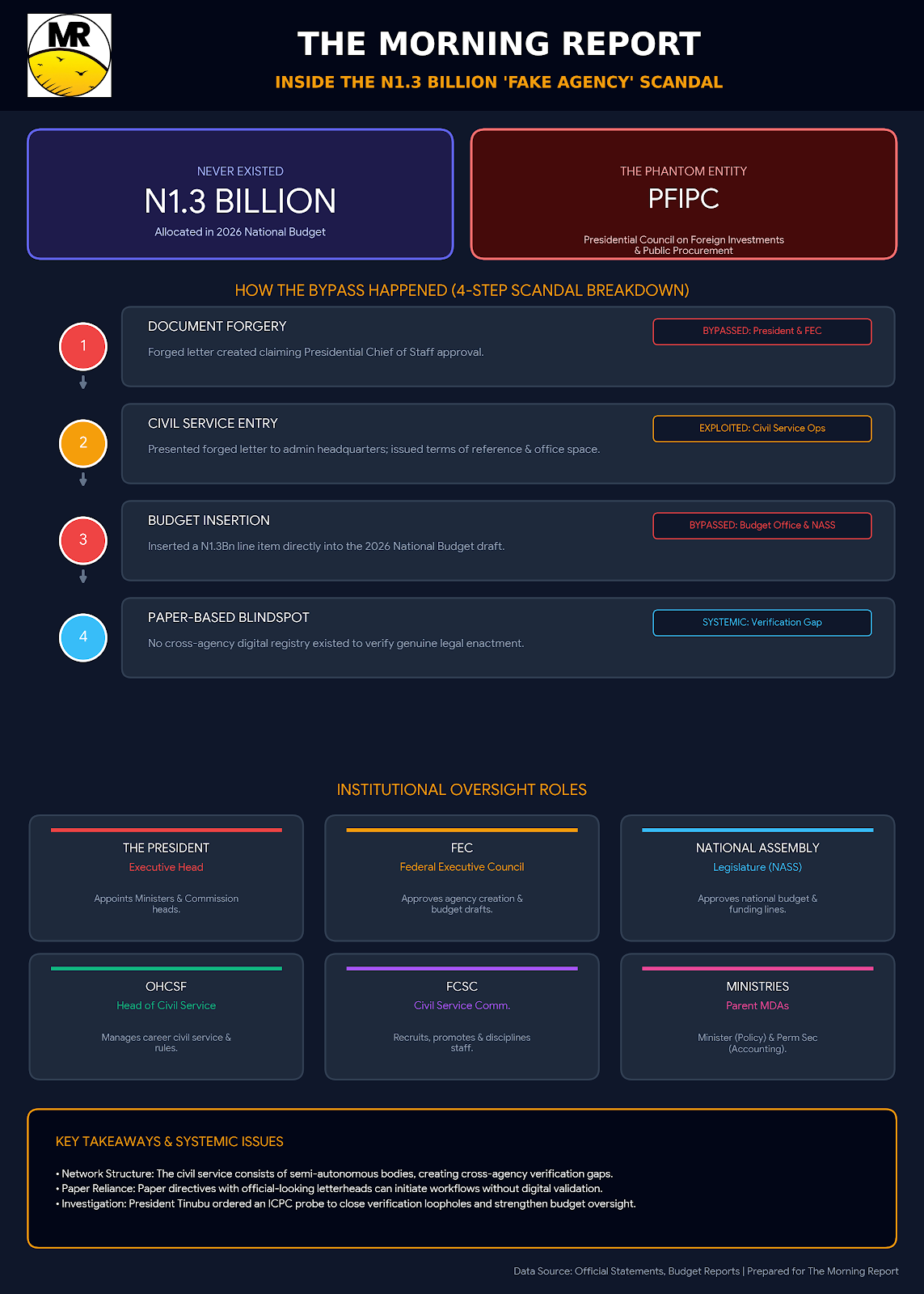
The Nigerian civil service possesses a unique ability to process paperwork for ghosts while ignoring living citizens. On Monday, Didi Walson-Jack faced a House of Representatives ad hoc committee. The Head of the Civil Service of the Federation went there to distance her office from a massive scandal. She testified about the Presidential Foreign Investment Promotion Council. Lawmakers suspect this council is a complete fabrication. They accuse Adeyemi Adeniyi of fraudulently presenting himself as its director-general using a fake presidential appointment. Walson-Jack confirmed that her office did not allocate space to this phantom agency at the Federal Secretariat. This absurdity mirrors the massive ghost worker syndicates discovered during the Goodluck Jonathan administration. The central judgment is clear. The Nigerian bureaucratic state operates on strict compliance rather than factual verification.
The mechanics of this fraud expose deep institutional rot within Abuja. The phantom council operated right under the nose of the federal government. They occupied a suite in the Federal Secretariat Phase III. Walson-Jack testified that the space actually belonged to the Office of the Secretary to the Government of the Federation. The OSGF routinely houses various presidential bodies and ad-hoc committees. The fraudulent council simply slipped into this jurisdictional grey area. The impostors understood that nobody questions a man with a government letterhead. They exploited the Nigerian deference to executive authority. This mirrors the tragic 2014 immigration recruitment scam. In that incident, a shadowy syndicate hijacked a government process for private gain.
Representative Musa Aliyu sits on the investigating committee. Speaking to reporters on 16 July 2026, he delivered a scathing assessment of the entire affair. He called the situation a spectacular failure of basic state security. He said that an impostor walking into a federal building and assuming power is worse than ordinary corruption. He argued that it exposes a total collapse of executive oversight. He warned that if someone can fake a presidential agency, they can fake anything.
Yet, civil servants continue to vigorously defend their strict adherence to procedure. A deputy director within the federal civil service spoke anonymously on a governance forum on 17 July 2026. He argued that civil servants are administrators, not intelligence officers. He said that if a document bears the correct presidential seals, they must process it. He insisted the civil service cannot be blamed for sophisticated forgery. He claimed that the burden of verification lies entirely with the security agencies.
This strict adherence to protocol explains the most shocking revelation from the hearing. The Head of Service actually approved a massive organisational structure for this dubious council. Walson-Jack admitted her office initially rejected the council’s request for lacking proper documentation. However, the council returned during the 2025 manpower budget defence exercise with an appointment letter. The bureaucracy then processed the application alongside 87 legitimate government agencies. They even granted a recruitment waiver for 314 positions a few days later.
Dr Samuel Ojo is a public policy lecturer at the University of Abuja. During a televised panel on 14 July 2026, he explained this structural vulnerability. He noted that the Nigerian civil service is fundamentally designed to process paper. It is absolutely not designed to verify reality. He explained that once a forged document enters the system, the system treats it as truth. He pointed out that civil servants rarely conduct site visits to verify the physical existence of ad-hoc councils. They simply move the file to the next desk.
The jurisdictional conflict between the Head of Service and the OSGF further complicated matters. Walson-Jack urged lawmakers to direct their operational enquiries to the OSGF. She insisted that presidential councils fall entirely outside her direct administrative mandate. She essentially washed her hands of the entire affair. Officials within the OSGF view the situation quite differently.
An aide to the Secretary to the Government defended their space management on a morning show on 18 July 2026. He argued that sharing office space with ad hoc presidential bodies is a standard administrative practice. He claimed the OSGF cannot actively police every individual walking through the massive secretariat doors. He insisted that inter-agency trust is necessary for the government to function smoothly. He accused the Head of Service of deflecting blame to protect her own department.
Barrister Amina Bello broke down this legal ambiguity during a radio interview on 15 July 2026. She explained that presidential councils often bypass statutory legislative approval. They exist entirely at the pleasure of the executive. This creates massive administrative blind spots across the government. She noted that neither the civil service nor the OSGF wants to take responsibility when things go wrong. She argued that the law desperately needs to define the oversight parameters for presidential ad-hoc bodies.
Anti-corruption advocates are entirely unimpressed by these bureaucratic excuses. Kemi Adegoke is a researcher with the Civil Society Network against Corruption. Writing in an op-ed published on 13 July 2026, she attacked the entire system. She wrote that this incident exposes the utter uselessness of internal government auditing. She argued that corrupt actors can simply invent an agency, secure a budget, and steal public funds unhindered. She noted that ordinary citizens face immense scrutiny to open a bank account. Meanwhile, connected individuals can seemingly conjure a federal parastatal out of thin air.
The reputational damage to Nigeria is severe and immediate. Tunde Lemo is a Lagos-based foreign investment consultant. He discussed the scandal on an economic podcast on 19 July 2026. He argued that fake investment councils actively destroy legitimate capital inflows. He said that foreign investors already struggle to navigate Nigerian bureaucracy. He explained that discovering they might be negotiating with a fraudulent government agency will drive all serious investors away. He warned that this scandal will likely increase the risk premium attached to Nigerian foreign direct investment.
Despite the mounting evidence of massive fraud, some voices still vigorously defend the embattled council. A former consultant for the council posted a lengthy defence on social media on 18 July 2026. He claimed the council was actually doing vital economic work. He insisted they were actively courting Asian investors before political rivals aggressively sabotaged them. He argued that the forgery allegations are merely a political witch-hunt. He claimed the investigation was designed to protect entrenched interests within the OSGF. He warned that the government is destroying a valuable tool for economic growth over petty jealousy.
This defence rings entirely hollow when you examine the actual outcomes. The council secured an establishment for 314 positions without any legislative backing. This is a classic briefcase agency setup. Political operatives invent a mandate, secure office space, and draw down a budget. They use recruitment waivers to sell civil service jobs to desperate citizens. This is a highly lucrative criminal enterprise dressed up as public administration.
The House ad hoc committee is now probing the alleged misuse of public funds. They want to know exactly how much money flowed into this phantom council. The answer will likely reveal a highly organised syndicate. Adeyemi Adeniyi could not have pulled this off alone. He needed inside help from the OSGF to secure the office space. He needed inside help from the Head of Service to push the recruitment waiver through the budget defence.
This is not a story about one rogue impostor. It is a story about a state apparatus that is entirely for sale. The civil service claims they only followed the paperwork. The OSGF claims they only provided the physical space. Everyone denies responsibility, yet the fraudulent agency thrived. This tactic of weaponising bureaucracy for personal enrichment is a staple of Nigerian governance. It thrives beautifully in the shadows between overlapping government mandates.
We must scrutinise the actual cost of this administrative negligence. Every Naira diverted to a fake investment council is a Naira stolen from real infrastructure. The government regularly complains about dwindling revenues and tight fiscal space. Yet, the civil service cannot identify a fake agency operating in their own headquarters. Until the executive branch audits its own presidential councils, this will happen again. The lawmakers must look beyond the fake director-general. They must aggressively expose the civil servants who knowingly processed his forged documents.
Winners: Bureaucratic insiders and briefcase contractors who exploit jurisdictional confusion to invent agencies and siphon public funds.
Losers: The Nigerian taxpayer who funds these phantom agencies, and legitimate foreign investors who face a compromised regulatory environment.
Bottom Line: A bureaucracy that processes paperwork without verifying reality is a willing accomplice to state capture.