


The continuous haemorrhaging of Nigeria’s medical talent has reached a catastrophic inflection point. The Coordinating Minister of Health and Social Welfare, Muhammad Ali Pate, recently laid bare the terrifying statistics. In the past five to seven years, an estimated 16,000 Nigerian doctors have fled the country. This mass exodus has plunged the national doctor-to-population ratio to a dangerous 3.9 per 10,000 citizens. This figure sits perilously below the minimum standards recommended by the World Health Organisation. We are essentially exporting our most critical human capital while domestic hospital wards remain empty and citizens die of preventable diseases. This continuous export of skilled labour mirrors the aggressive brain drain of the late 1990s, when political instability drove professionals abroad. Today, the driver is purely economic survival.
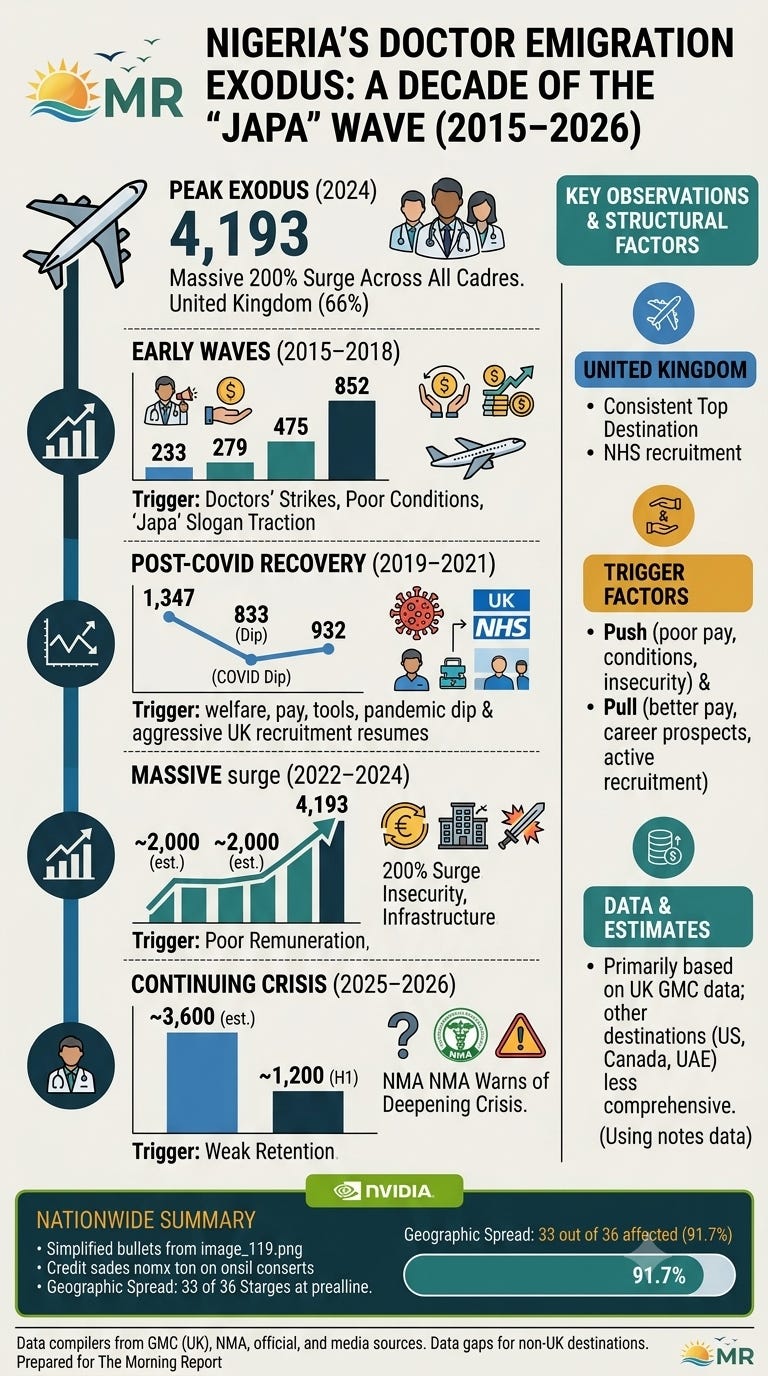
The mechanics of this crisis are rooted in a fundamentally broken state incentive structure. The Nigerian state invests heavily in subsidised medical education, only for foreign nations to reap the ultimate dividends. Minister Pate explicitly quantified this horrific financial bleed during a recent capacity-building workshop in Abuja. He noted that training a single medical doctor in Nigeria costs the state upwards of $21,000. When 16,000 doctors leave, that represents over $336 million in public financing literally walking out the door. We are subsidising the healthcare systems of the United Kingdom, Canada, and Saudi Arabia with scarce Nigerian taxpayer funds. Meanwhile, our own rural primary healthcare centres remain severely understaffed and entirely dysfunctional.
The Nigerian Medical Association (NMA) is desperately demanding an immediate and complete overhaul of the domestic healthcare environment. The association insists that retaining medical talent requires much more than simple moral appeals to patriotism. Dr. Oladimeji Sule is a senior consultant and active NMA member in Lagos. Speaking on a medical advocacy podcast on 25 July 2026, he outlined the stark reality facing young resident doctors. He argued that doctors are not merely chasing luxury; they are fleeing absolute occupational hazard. He explained that working 72-hour shifts in hospitals lacking basic oxygen supplies or functional surgical theatres breaks a doctor’s spirit. He insisted that until the government guarantees basic clinical infrastructure, the emigration will only accelerate.
Federal health officials are actively trying to counter this narrative with new policy frameworks. Minister Pate recently highlighted the National Policy on Health Workforce Migration as a core component of the administration’s strategy. He argued that this new policy is not restrictive but rather designed to manage the migration with dignity. He claimed the policy aims to establish ethical recruitment agreements with destination countries while simultaneously expanding domestic training capacity. He insisted the government is focused on retaining the remaining workforce and eventually reintegrating Nigerian professionals currently practicing abroad.
However, medical professionals on the ground view these policy documents with intense, earned cynicism. Dr. Amina Bello is a paediatrician working in a sprawling government hospital in Kano. During a radio interview on 24 July 2026, she dismissed the new policy framework as bureaucratic window dressing. She stated that ethical recruitment agreements do not fix broken incubators or provide uninterrupted power to intensive care units. She argued that the government must drastically increase the budgetary allocation for health to retain staff. She noted that her colleagues are leaving because a single month’s salary in the UK covers a year of earnings in Nigeria.
The profound impact of this mass migration is incredibly uneven across the country. The remaining 55,000 licensed doctors in Nigeria are heavily concentrated in major urban centres. Lagos and Abuja absorb a disproportionate share of the available medical talent. Minister Pate acknowledged this severe geographical disparity, noting that the doctor-to-population ratio in Abuja is significantly higher than the national average. This concentration leaves vast swathes of rural Nigeria, particularly the North and remote riverine communities, entirely bereft of qualified medical care. A farmer in rural Borno essentially has zero access to a licensed physician, forcing reliance on untrained traditional healers.
The National Association of Resident Doctors (NARD) has repeatedly warned that the current workload is physically destroying those who remain. Emeka Orji, the President of NARD, previously revealed that the association’s numbers have plummeted drastically. He noted that the remaining doctors are forced to cover the shifts of their departed colleagues, leading to severe burnout and clinical errors. A tired doctor in an under-equipped hospital is a recipe for medical disaster. The state is systematically burning out its remaining medical professionals by refusing to hire replacements or improve their working conditions.
International recruitment agencies aggressively target Nigerian medical graduates, fully aware of their desperation. A human resources consultant for a UK-based healthcare trust spoke anonymously to a regional healthcare journal on 23 July 2026. He admitted that Nigerian doctors are highly prized because they are well-trained, English-speaking, and desperate to leave. He noted that the UK National Health Service relies heavily on this continuous pipeline of cheap, highly qualified African labour. He argued that it is entirely irrational to expect a Nigerian doctor to reject a guaranteed middle-class life in Europe for poverty wages at home.
This crisis demands a brutal reassessment of how Nigeria values its human capital. We cannot continue to treat medical professionals as indentured servants expected to suffer indefinitely for national pride. The government must aggressively adjust medical salaries to reflect the horrific inflationary environment. Furthermore, the state must explore radical solutions, such as offering state-backed mortgages or tax exemptions for doctors who commit to rural postings. Without immediate, massive financial intervention, the Nigerian healthcare system will collapse completely.
Winners: Foreign healthcare systems in the UK and North America that acquire fully trained medical professionals without bearing the initial educational costs.
Losers: The Nigerian taxpayer who funds medical training, and ordinary citizens who face a severely degraded and understaffed healthcare system.
Bottom Line: Until the state matches its rhetoric with massive financial investments in hospital infrastructure and competitive wages, the mass exodus of doctors will remain a perfectly rational economic choice.