


Under the intense glare of the afternoon sun along the Expressway in Lagos, traffic moves in a relentless, chaotic surge, while in Abuja, wide asphalt avenues echo with the hum of long-distance urban commutes. For nearly a decade, the familiar black-and-white icon of Uber was a ubiquitous sight across both metropolises, serving as the pioneer that introduced app-based mobility to Nigeria’s commercial and political capitals. However, Uber's unexpected official exit from the Nigerian market has fundamentally rewritten the rules of the country’s digital transport landscape overnight. What was once a three-way tug-of-war for urban dominance has abruptly become a high-stakes war of attrition between the two remaining giants: Bolt and inDrive. In the wake of Uber’s withdrawal, a massive vacuum has opened across the ride-hailing ecosystem, setting off an unprecedented race to capture hundreds of thousands of displaced passengers and thousands of newly unattached drivers.
Across key transit hubs, fuel stations, and digital corridors in Lagos and Abuja, the battle for market share is unfolding with aggressive intensity. Pop-up registration centres, complete with brightly coloured canopies and banner-bearing representatives, have sprung up near popular driver staging points, offering instant sign-up bonuses, free vehicle inspections, and reduced commission windows. At the same time, smartphone screens across the country are being flooded with notification banners, influencer campaigns, and steep promotional discounts designed to lure commuters whose default ride-hailing habit has been suddenly disrupted.
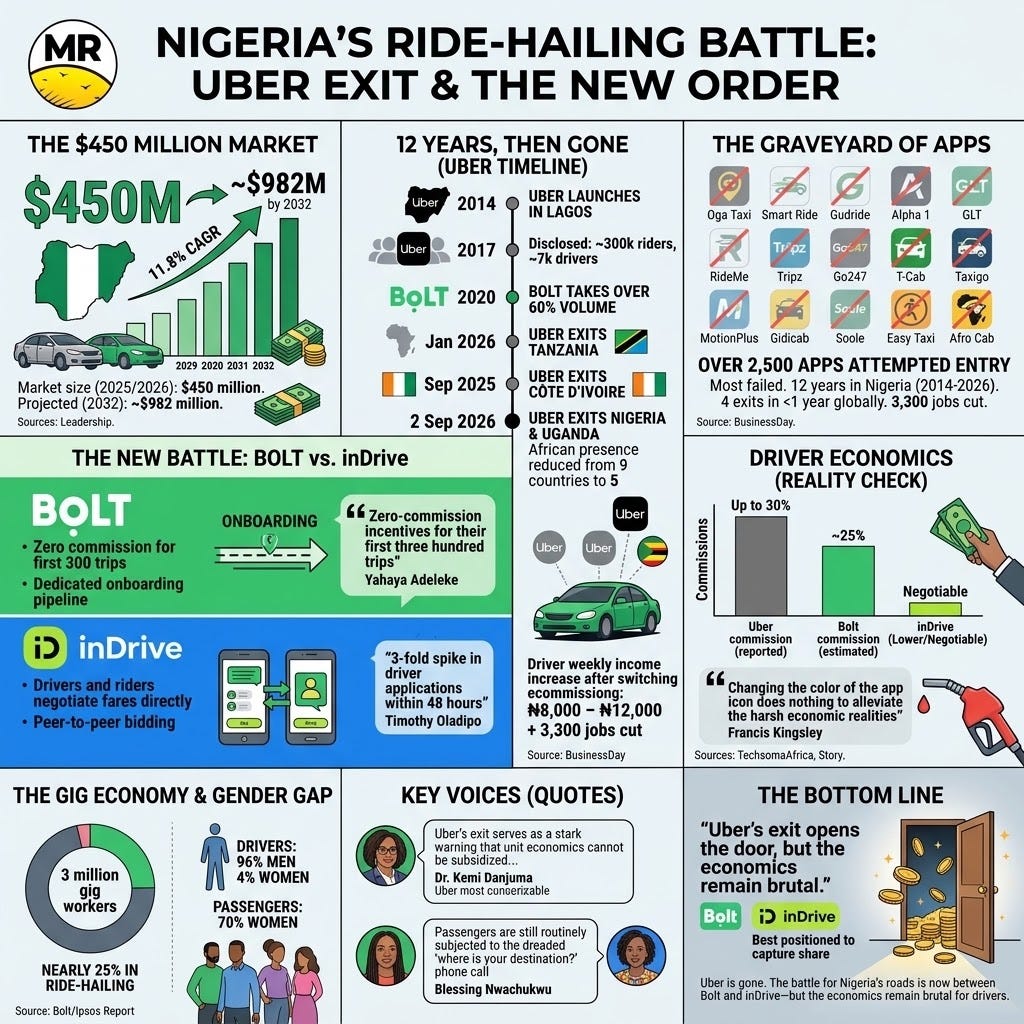
Moving quickly to consolidate its foothold as the established market leader, Bolt has launched a multi-front offensive to convert former Uber drivers into permanent platform loyalists. Speaking in Lagos on August 29, 2026, Yahaya Adeleke, Senior Operations Lead at Bolt Nigeria, framed the current expansion as a strategic moment to redefine urban transit reliability. Adeleke said the company immediately activated a dedicated onboarding pipeline tailored for ex-Uber partners, streamlining background verification checks and offering zero-commission incentives for their first three hundred trips. He emphasised that Bolt’s primary objective is to absorb the surge in demand without sacrificing service delivery, saying the platform’s heavy investment in driver welfare programmes and automated safety tools shows a long-term commitment to the Nigerian market that outlasts transient competitors.
Yet, as Bolt relies on its entrenched algorithmic dispatch model and established brand equity, inDrive is mounting a formidable counter-campaign built around its signature peer-to-peer bidding mechanism. By allowing riders and drivers to negotiate fares directly rather than relying on an automated black-box algorithm, inDrive is pitching itself as the fairer, more transparent alternative in an economy where inflation has made fixed pricing increasingly contentious. Detailing the company’s aggressive push into the market void, Timothy Oladipo, Head of Regional Expansion at inDrive Africa, outlined their strategic positioning on August 31, 2026. Oladipo said inDrive saw a three-fold spike in driver applications within forty-eight hours of Uber’s exit announcement. He argued that both commuters and drivers have grown deeply exhausted by rigid algorithmic pricing models that fail to reflect real-time fuel prices or localised traffic delays. Oladipo stressed that by keeping platform commissions significantly lower and giving drivers full freedom to set fares, inDrive is democratising app-based transport across Abuja and Lagos, positioning itself as the true champion of economic autonomy for Nigerian drivers.
However, beneath the glossy corporate messaging and aggressive sign-up bonuses lies a far more complicated reality for the workers behind the wheel. For the thousands of drivers navigating Nigeria’s challenging macroeconomic terrain, switching platform allegiances offers only temporary relief against deep structural pressures. Fuel prices remain exorbitantly high, vehicle maintenance costs have skyrocketed due to foreign exchange volatility, and daily operational margins are continually squeezed. Expressing deep scepticism regarding the promotional promises of both rival platforms, Francis Kingsley, General Secretary of the Amalgamated Union of App-Based Transport Workers of Nigeria (AUATWON), delivered a scathing assessment on September 1, 2026. Kingsley argued that changing the colour of the app icon on a smartphone screen does nothing to alleviate the harsh economic realities facing drivers on the road. He pointed out that while Bolt and inDrive are spending millions on driver acquisition campaigns, neither platform has effectively addressed the workforce's core grievances: unsustainable commission structures, arbitrary account suspensions, and the lack of genuine health or insurance safety nets. Kingsley warned that if the remaining operators simply attempt to exploit Uber’s former driver base without offering guaranteed minimum earnings or structural fare reviews that match current fuel prices, driver dissatisfaction will inevitably lead to widespread platform fatigue and organised labour disruptions.
This friction between platform expectations and driver realities directly spills over into the passenger experience. For daily commuters in Lagos and Abuja, the corporate battle for dominance has yielded mixed results. While promotional discount codes render fares temporarily attractive on paper, the practical experience of booking a ride remains fraught with familiar frustrations. Highlighting the ongoing hurdles faced by commuters, Blessing Nwachukwu, a corporate communications executive and daily Lagos rider, shared her perspective on September 2, 2026. Nwachukwu noted that while the influx of promo codes from both Bolt and inDrive looks appealing, the fundamental user experience has not meaningfully improved. She explained that passengers are still routinely subjected to the dreaded “where is your destination?” phone call from drivers attempting to screen trips, widespread cancellations, and persistent requests to take rides offline or pay extra cash to cover fuel costs. Nwachukwu observed that until the remaining operators can enforce strict service standards and curb offline fare manipulation, aggressive marketing campaigns will merely act as a temporary band-aid over a broken customer service model.
The sudden exit of a global heavyweight like Uber also raises fundamental questions about the long-term viability of tech-enabled mobility in West Africa’s largest market. Uber’s departure was not an isolated event, but rather the culmination of years spent battling severe currency devaluation, high operational overheads, and shifting regulatory frameworks. Analysing the broader macroeconomic forces driving this market realignment, Dr Kemi Danjuma, a Senior Fellow in Urban Transport and Tech Policy at the Lagos Business School, offered a sober assessment on September 3, 2026. Dr Danjuma explained that Uber’s exit serves as a stark, definitive warning that unit economics in African urban mobility cannot be subsidised by foreign venture capital indefinitely. She noted that operating in Nigeria requires navigating a unique combination of infrastructural bottlenecks, volatile input costs, and declining consumer purchasing power. Dr Danjuma emphasised that while Bolt and inDrive are currently locked in a fierce battle for market share, their long-term survival depends on whether they can achieve genuine operational efficiency rather than relying on endless capital-burning promo cycles that distort true market value.
This operational reality is particularly evident to commercial fleet operators who manage large portfolios of vehicles across multiple platforms. Fleet managers, who provide the structural backbone for much of the ride-hailing supply in Abuja and Lagos, view the market transition through the pragmatic lens of asset protection and daily revenue returns. Offering an insider perspective on fleet reallocation, Chuka Ezenwa, a commercial fleet manager overseeing sixty vehicles in Abuja, outlined his operations on September 4, 2026. Ezenwa stated that his firm had successfully migrated its entire vehicle fleet from Uber over to a hybrid distribution between inDrive and Bolt within a matter of days. He acknowledged that while sign-up incentives and lower initial commission tiers provided a welcome boost to immediate cash flow, his primary operational focus remains driver safety and vehicle longevity. Ezenwa urged both surviving platforms to urgently prioritise robust rider verification systems and real-time emergency response integration, warning that criminal targeted attacks against drivers remain a terrifying threat that no amount of promotional marketing can erase.
As the dust settles on Uber’s historic departure, the battle for Nigeria’s ride-hailing supremacy is entering a decisive, high-intensity phase. Bolt and inDrive find themselves standing at a critical juncture, navigating a market defined by immense demand yet constrained by severe economic headwinds. The aggressive driver onboarding drives and passenger discount campaigns currently sweeping across Lagos and Abuja may succeed in carving up Uber’s legacy market share in the short term. However, promotional codes or flash recruitment tents alone will not secure long-term dominance. The platform that ultimately wins the war for Nigeria’s roads will be the one that successfully balances corporate profitability with genuine driver sustainability, offering fair wages to workers, safety to vehicle owners, and reliable, dignified service to the millions of commuters who depend on digital mobility every single day.
The winners: Bolt and inDrive, which can capture Uber’s market share; and Nigerian drivers and passengers, who may benefit from increased competition and promotional offers. The losers: Uber, which has exited the market; and the Nigerian ride-hailing industry, which faces an uncertain future without a global heavyweight to anchor the market.
Bottom Line: Uber is gone. Bolt and inDrive are fighting for the scraps. The question is whether either platform can build a sustainable business model in Nigeria’s challenging economic environment.