


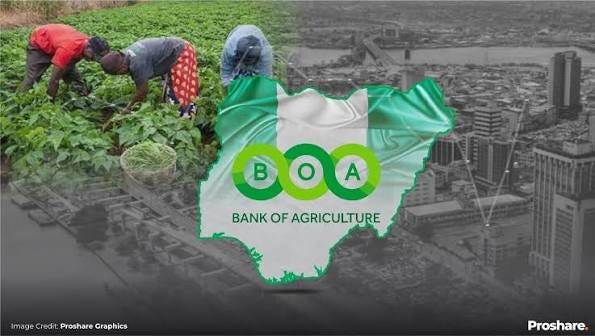
The Bank of Agriculture has entered a strategic partnership with the All Farmers Association of Nigeria to expand access to financing for the 2026 dry season farming cycle. The initiative, implemented under the BOA Renewed Hope Smallholder Support and Value Chain Fund, targets about 400,000 farmers.
BOA Managing Director Ayotunde Sotinrin said AFAN will identify credible farmers within its national network, providing information on their locations, commodities, farm sizes and proposed dry-season acreage. AFAN will also identify Farmer Aggregation Companies with verifiable farmer networks and the capacity to coordinate participating farmers.
“Through the Farmer Allocation Model, approved financing will be provided to eligible participating farmers through suitable FACs, which will serve as obligors and coordinate the allocation and deployment of approved inputs and other production requirements,” Sotinrin said.
The support goes beyond agricultural inputs. It includes irrigation equipment, helping farmers reduce dependence on rainfall and maintain production through the dry season. The financing model is designed to connect farmers with the capital, inputs and equipment they need, while channelling funds through credible structures with clear farmer networks and production plans.
This mirrors the Federal Government’s broader push to expand agricultural financing through intervention funds. The BOA has signed similar partnerships with WACOT for farm inputs in Jigawa and with the Federal Ministry of Women Affairs for women farmers. The difference now is scale. Four hundred thousand farmers is not a pilot. It is a national programme.
The human stakes are about food security. Nigeria’s food inflation has remained stubbornly high, driven by insecurity, transport costs and exchange-rate pressures on imported inputs. Dry-season farming extends production beyond the main rainy season, smoothing supply and stabilising prices. If 400,000 farmers receive financing and irrigation equipment, the effect on household food supply could be significant.
Winners and Losers
Winners: The 400,000 farmers targeted by the programme, who gain access to financing and irrigation equipment. AFAN, which consolidates its role as the primary farmer aggregation platform. BOA, which builds a credible pipeline of agricultural borrowers. Nigerian households, which stand to benefit from more reliable food supply.
Losers: Rain-fed farmers outside the programme, who face competition from better-capitalised dry-season producers. Informal lenders, who lose borrowers to single-digit BOA loans. Taxpayers, who fund the intervention if repayment rates disappoint.
Bottom Line: Irrigation is the difference between farming and gambling. BOA is giving 400,000 farmers a hedge against the rain. If the loans are repaid and the food reaches markets, it is a bargain.