


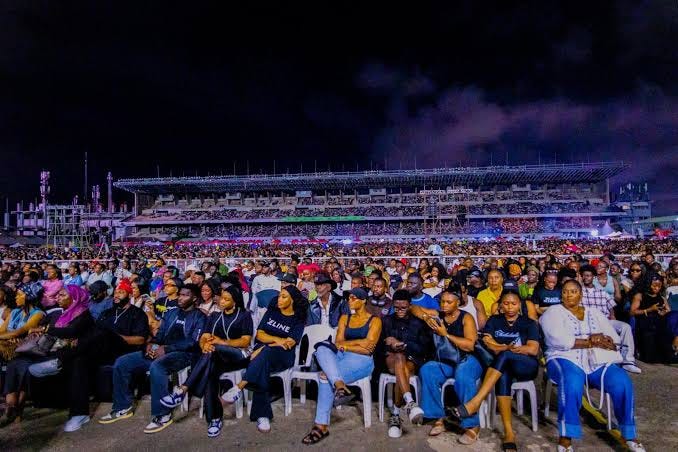
Nollywood’s Black Market has broken the Guinness World Record for the largest attendance at a film screening in a single location. More than 51,000 people watched the crime thriller at Tafawa Balewa Square in Lagos on Saturday.
Guinness World Records confirmed the feat after the screening. The previous benchmark of 43,624 attendees had stood for more than a decade.
FilmOne, the film’s distributor, announced the record on social media. “51,000+ people. One screen. One moment that just made history,” the company said.
The film follows five market women involved in a cross-border smuggling operation amid fuel scarcity and economic pressure. Their lives change when one of their daughters is kidnapped. Fatimah Binta Gimsay directed the film. Nora Awolowo produced it.
The screening was designed as a cultural statement, not just a premiere. Omowunmi Dada, an executive producer, said the goal was to move beyond the conventional cinema release. “Instead of the regular ‘take your film to the cinema,’ let’s do something more iconic,” she said. “Something that is a cultural statement, not just for Lagos, not just for Nigerian creatives, but for young people and Nigerians as a whole.”
This mirrors the trajectory of Afrobeats, which built global reach without waiting for Western validation. Nollywood produces more films than any industry outside India. But its distribution and monetisation infrastructure remains weak. A Guinness World Record generates international visibility without requiring that infrastructure.
The logistics were substantial. Gates opened at 2:00 pm. A red-carpet session followed at about 3:00 pm. The main screening ran from 7:00 pm to 8:30 pm. The event included music, food and games. Lagos State Deputy Governor Obafemi Hamzat attended, alongside Commissioner for Tourism, Arts and Culture Toke Benson, and Nollywood figures including Lateef Adedimeji, Kunle Remi, Linda Ejiofor and Kunle Afolayan.
Winners and Losers
Winners: FilmOne and the producers, who gain global media attention. Nollywood, which receives international recognition for scale. Lagos State, which burnishes its credentials as a cultural capital.
Losers: Local cinemas, which lose a premiere that would have generated footfall. Attendees who faced crowd management risks at a venue designed for smaller gatherings. The record itself, which will be challenged and eventually surpassed.
Bottom Line: A Guinness World Record is a statement of ambition. Nollywood has proved it can gather a crowd. The harder task is monetising that crowd.