


The boardrooms sit high above Victoria Island and Abuja’s central business district. Below them, traders queue at bus stops, haul goods through flooded streets and borrow at rates above 30%. The two worlds share a country but not an economy. New financial disclosures show that bank executive pay is rising faster than bank profits. At First HoldCo and Zenith Bank, the divergence is stark.
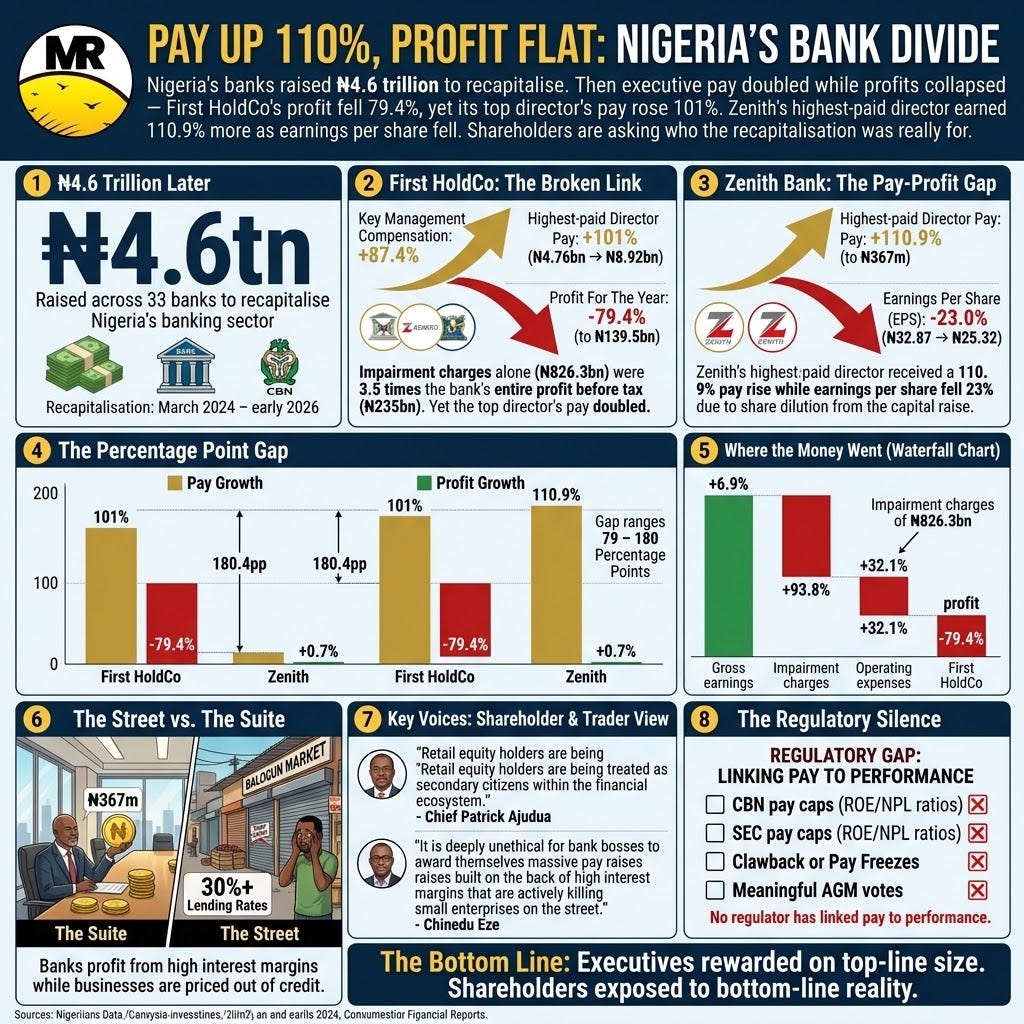
First HoldCo grew gross earnings by 6.9% to ₦3.44 trillion. Net interest income rose 36.8% to ₦1.92 trillion. Then the bottom line collapsed. Profit before tax fell 70.5% to ₦235 billion. Profit for the year dropped 79.4% to ₦139.5 billion. Credit impairment charges surged 93.8% to ₦826.3 billion. Operating expenses climbed 32.1% to ₦1.23 trillion. Against that backdrop, the highest-paid director’s remuneration doubled to ₦195 million. Key management compensation, covering executive directors and the top management committee, rose from ₦4.76 billion to ₦8.92 billion.
Zenith Bank followed the same script. Gross earnings rose 5.6% to ₦4.19 trillion. Profit after tax inched up 0.7% to ₦1.04 trillion. Profit before tax actually fell 4.8% to ₦1.26 trillion. The highest-paid director’s pay jumped 110.9% to ₦367 million. Total executive compensation rose from ₦3.78 billion to ₦5.88 billion. Earnings per share fell from ₦32.87 to ₦25.32 after share dilution from the capital raise. Shareholders absorbed the dilution. Directors absorbed the increase.
The recapitalisation context
The Central Bank of Nigeria (CBN) launched its recapitalisation drive in March 2024. It concluded in early 2026. Banks had to raise minimum capital, with international licence holders needing ₦500 billion. The industry raised over ₦4.6 trillion across 33 institutions. Rights issues, public offers and private placements did the work. Capital adequacy ratios rose above international benchmarks. Balance sheets were fortified.
But recapitalisation did not fix the real economy. The CBN’s high Monetary Policy Rate let banks earn lucrative yields on government securities and floating-rate loans. Gross interest income rose across the sector. The same high rates crushed borrowers. Non-performing loans rose in manufacturing, agriculture and real estate. Banks are earning more on paper and lending less in practice. The result is a sector that looks strong in capital terms and weak in its connection to production.
The analyst’s warning
Muhammed Lawal, a senior financial analyst and market intelligence researcher, examined the audited statements on 18 September 2026. He said the alignment between executive incentives and shareholder returns is broken. “When director compensation doubles during periods where profit after tax barely moves or drops by nearly 80%, the fundamental alignment is broken,” he said. He argued that gross earnings are inflated by the interest rate regime, while the quality of earnings deteriorates under credit losses. Boards, he said, reward executives for top-line size rather than operational efficiency.
The defence
Olamide Thomas, a senior banking consultant and corporate board advisor, offered a different view in Lagos on 15 September 2026. He said evaluating pay solely against short-term profit ignores the complexity of the job. Nigerian bank directors, he argued, manage multi-trillion naira balance sheets through hyper-inflation, currency volatility and heavy regulatory compliance. “Successfully navigating a ₦500 billion recapitalisation while managing multi-trillion naira balance sheets requires exceptional leadership,” he said. He warned that inadequate pay would push Nigeria’s best financial minds to international institutions and global fintech firms. The retention argument is real. It is also the standard defence offered every time pay outpaces performance.
The shareholders’ anger
Chief Patrick Ajudua, President of the Independent Shareholders Association of Nigeria, rejected that defence on 14 September 2026. He said retail equity holders are treated as secondary citizens. Shareholders suffered dividend suspensions and earnings per share dilution during the recapitalisation. Executive directors insulated themselves with multi-hundred-million naira increases. He asked why board remuneration committees approve bonuses when net profits contract. He wants pay clawed back or frozen when shareholder returns lag.
His complaint points to a structural problem. Executive pay packages go to shareholders at annual general meetings. In theory, shareholders approve. In practice, institutional blocks and founding directors control the votes. Retail investors hold little sway. Consent becomes a formality.
The street view
Chinedu Eze, a medium-scale textile importer at Balogun Market, spoke on 16 September 2026. He said banks announce multi-trillion naira earnings and pay directors hundreds of millions while merchants borrow above 30%. “Small businesses cannot access affordable credit to maintain inventory or pay staff,” he said. He also complained about fees on digital transfers and card transactions. He called it unethical for bank bosses to award themselves raises built on high interest margins that are killing small enterprises.
The regulatory silence
Neither the CBN nor the Securities and Exchange Commission has issued guidelines tying executive pay to return on equity or non-performing loan ratios. Nigerian bank executives earn less in absolute dollar terms than peers in South Africa or Kenya. The issue is not absolute pay. It is the ratio between reward and performance. In a sector that benefited from public policy support, liquidity injections and regulatory forbearance, the optics of enrichment during hardship are damaging.
Dr Bisi Afolabi, a financial economist and governance researcher at the University of Lagos, reflected on the paradox on 17 September 2026. She said the banking sector has detached itself from the economic reality of the population it serves. Current compensation trends, she argued, encourage short-termism. Bank managers chase high-yield margins rather than building sustainable credit portfolios that support industrialisation. Until regulators tie pay to sustainable return on equity, asset quality and real-sector credit expansion, she said, the gap between the executive suite and the street will keep widening.
The historical parallel
This is not new. A 2022 audit showed Nigerian bank chief executives earning multiples of their peers in manufacturing and consumer goods. The recapitalisation was meant to strengthen the sector and restore confidence. It did strengthen capital. It did not change the culture. Two years after the exercise began, the pay-profit divergence is wider than before.
Winners: Bank executive directors, whose pay doubled while profits fell. Board remuneration committees, which approved the packages. International recruitment consultants, who benchmark the numbers upward. Institutional investors, whose votes control the process.
Losers: Retail shareholders, whose earnings per share fell through dilution. Small businesses, which borrow above 30% or not at all. Bank employees below executive level, whose salaries grew far slower. Depositors, who earn low rates on savings. The CBN, whose recapitalisation produced capital strength without governance reform. The real economy, which remains starved of affordable credit. Public trust in banking, which erodes with every disclosure.
Bottom Line
A bank director’s pay doubled while profit fell by nearly 80%. Shareholders approved it. The regulator stayed silent. Recapitalisation strengthened balance sheets and left governance untouched. Until pay is tied to return on equity and asset quality, Nigerian banks will keep rewarding executives for the size of the balance sheet rather than the health of the economy around it.