


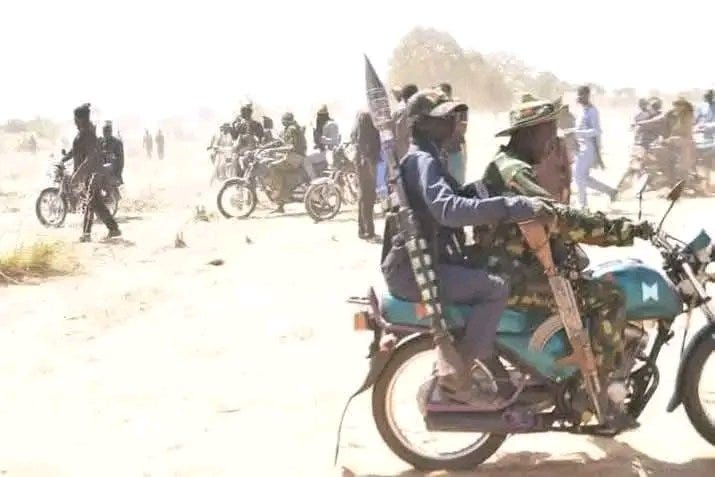
The northwest security crisis deepened on Thursday with a brazen attack on an internally displaced persons camp in Sokoto State. Gunmen on about 20 motorcycles stormed Gangara village in Sabon Birni Local Government Area, killing three IDPs and abducting more than 20. The victims were among those who had fled previous attacks in surrounding communities, only to come under renewed assault in their place of refuge.
One of the displaced women, Yarmagaji, a widow and mother of five from Tungar Barke, said her children — all orphans — were among those kidnapped. Abubakar Muhammad, who sustained multiple gunshot wounds to his left hand, described the attack: “I tried to escape, but one of them chased me, ordered me to stop, and when I refused, he opened fire. Several bullets hit my hand and I lost consciousness”. Sabon Birni, located near the border with Niger, has remained one of the worst-hit areas by armed bandit groups that routinely raid villages, kill residents, rustle livestock and kidnap for ransom.
Police spokesperson Ahmad Rufa’i said efforts were underway to rescue the victims. But the attack exposes the growing vulnerability of IDPs in the northwest, where many have sought shelter in neighbouring villages rather than formal displacement camps due to limited humanitarian support. This is the grim arithmetic of Nigeria’s security crisis: those who flee violence are not safe, and those who stay are not safe either.
In Lagos, the Army’s 65 Battalion arrested 24 foreign nationals during a raid on a suspected hideout in Epe Local Government Area. The suspects, comprising 15 males and nine females, are citizens of Cameroon, Togo, Côte d’Ivoire, Benin, Burkina Faso and Guinea-Bissau. The Army handed them over to the Nigeria Immigration Service for profiling and investigation. The operation, described as intelligence-led, reflects the military’s growing role in internal security — a role that has expanded significantly since the counter-insurgency operations of the 2010s.
The contrast between the two stories is instructive. In Sokoto, bandits operate with impunity, attacking even those who have already been displaced. In Lagos, the Army conducts targeted raids against undocumented migrants. One operation protects civilians; the other is a response to a crisis that has already occurred. The imbalance reflects a broader reality: Nigeria’s security apparatus is better at reacting than at preventing, and the human cost of that reactive posture is measured in lives lost and futures stolen.
Winners: The Nigerian Army (for the Lagos raid), the Nigeria Immigration Service.
Losers: IDPs in Sokoto, families of the abducted, the credibility of the government’s security promises.
Bottom Line: The attack in Sokoto is a reminder that Nigeria’s security crisis is not improving; it is merely shifting, and the displaced are paying the price.