


Dawn breaks over the commercial outskirts of Aba. A residential compound sits behind high walls and barbed wire. Armed operatives of the National Agency for the Prohibition of Trafficking in Persons breach the gate. Inside, they find locked rooms. Dozens of young pregnant women are held there. Some are teenagers. Some are malnourished. Some are in labour. All are trapped in an industrial cycle of human commodification.
Historical background
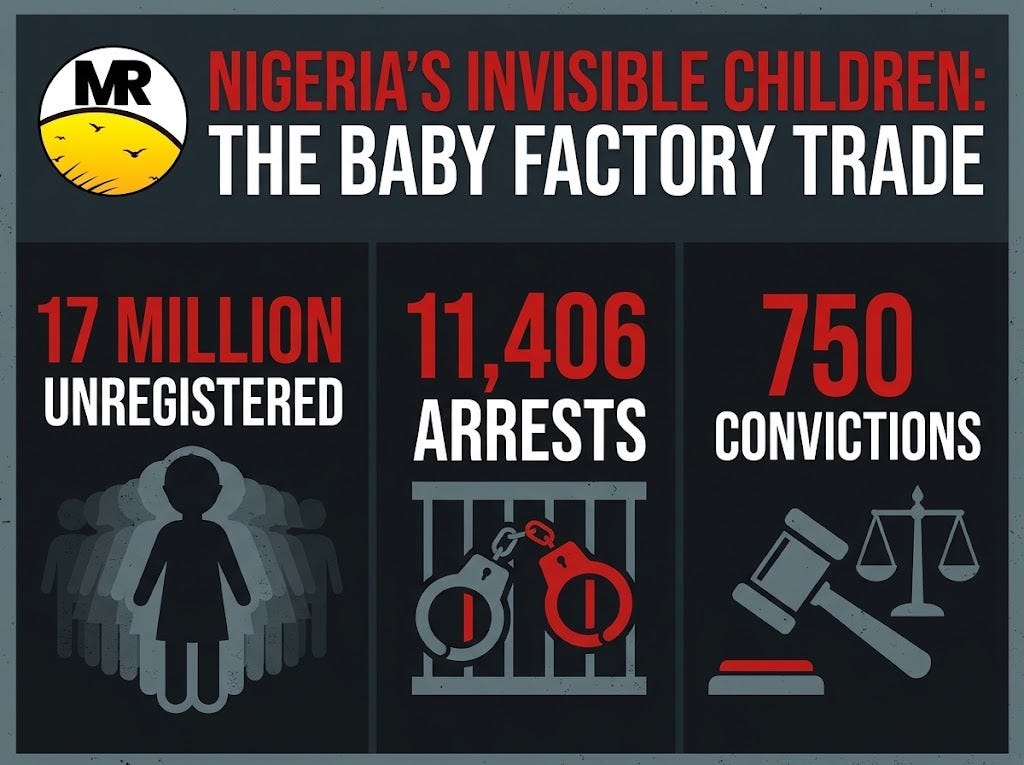
Nigeria domesticated the United Nations Convention on the Rights of the Child through the Child Rights Act 2003. The Act does not apply automatically nationwide. Each state assembly must domesticate it. Years after passage, several states still have not. The result is a patchwork of standards across state lines. NAPTIP was established the same year. It has recorded thousands of investigations and rescued many victims. Its capacity is dwarfed by the scale of the syndicates. Convictions remain painfully low relative to arrests. Trials drag. Evidence is weak. Forensics are scarce. Baby factories sit where trafficking, illegal adoption, reproductive exploitation and poverty meet. No single agency can dismantle that alone.
This is not a new crime. It is a persistent one. Raids happen in Onitsha, Lagos, Port Harcourt and Aba. Each produces headlines, condemnations and arrests. Each is followed by promises that the network has been crushed. Within months, the trade resumes under a new name. To treat these facilities as isolated criminal dens is to misread them. They are symptoms of structural decay.
The legal void
Barrister Nkiru Okoro is a Lagos-based child rights attorney. She explained how syndicates exploit the gaps. “When you raid a baby factory, you capture the immediate perpetrators, the clinic operators, the security guards, and sometimes the registered nurses who moonlight as midwives,” she said. “But you rarely dismantle the financial and legal backers behind them. Because our birth registration system is porous and our adoption laws vary from state to state, traffickers know they can launder these babies through informal adoption channels or corrupt social welfare conduits with minimal risk of severe judicial consequences. Until our laws treat child trafficking and illegal adoption with the same unyielding severity as terrorism, the risk-reward ratio will always favour the criminals.”
Her point is precise. The raid captures the visible. The invisible continue. The money and the legal cover sit behind the clinic. They remain untouched.
The invisibility engine
Millions of Nigerian children are invisible to the state. The National Population Commission’s civil registration system is incomplete and underfunded. Large parts of rural and semi-urban births go unrecorded. Millions of children have no birth certificate, no digital identity and no paper trail. Trafficking thrives in that gap. A child without a record can be moved, renamed and resold. The state cannot trace what it never registered.
Formal adoption is slow, opaque and expensive. Prospective parents face years of red tape, arbitrary fees and gatekeeping within state welfare ministries. Many couples carry the social stigma of infertility. Desperate to build a family, some turn to informal networks. They may know or suspect the child’s origin. They pay anyway. The black market meets the demand the state has failed to serve.
On the supply side, poverty does the recruiting. Syndicates target young women from rural backgrounds who face unintended pregnancy, abandonment or destitution. They promise shelter, medical care and a modest payout on delivery. The sums range from ₦150,000 to ₦300,000. The baby is resold for millions. Human life becomes a high-yield commodity.
Dr Emeka Eze is a public health researcher who studies vulnerable populations. He spoke at a seminar in Port Harcourt. “You cannot fight baby factories purely with police raids,” he said. “You are fighting a market driven by two powerful economic forces: absolute desperation on one side and unyielding consumer demand on the other. When a young girl in a rural community cannot afford basic nutrition or shelter, and an unlicensed clinic offers her cash for a baby she cannot feed, vulnerability overpowers morality. Conversely, when infertile couples face a dysfunctional government adoption system that takes four years of frustrating clearance processes, they become sitting ducks for predatory traffickers. The state must fix the front door of legal adoption and child support, or criminals will continue running the back door.”
The human cost
The victims are punished twice. First by the traffickers. Then by the state’s response. Rescued young mothers face intense stigma. Families ostracise them. Psychological support is scarce. Economic reintegration is rarer. The infants face an equally precarious fate. Well-funded orphanages are few. Children are placed in overcrowded institutions or, in some cases, returned to the extended families whose neglect made their mothers vulnerable.
Sister Veronica Onuah coordinates a faith-based shelter for rescued teenage mothers in Aba. She described what she sees. “When these girls arrive at our shelter after a raid, they are broken physically and mentally,” she said. “Many were told by the clinic operators that they were doing them a favour by taking away a child they could never afford to raise. They carry deep guilt, trauma, and fear of being arrested themselves. When they look around, they do not see a protective government; they see a system that reacts with noise when the cameras are rolling, but abandons them the moment the news cycle moves on. Healing a broken mother and securing an identity for a child requires consistent, long-term care, not just a one-day police operation.”
The fragmentation
The police, NAPTIP, state ministries of women affairs, local welfare departments and health regulators all hold nominal responsibility for child protection. They operate in silos. Coordination is weak. Raids are reactive. They follow anonymous tips, journalist investigations or social media exposés. Proactive intelligence gathering is rare. The system responds to noise. It does not prevent the crime.
The economy of exploitation
The architecture of this trade produces clear winners and losers. The winners are the clinic operators and traffickers, who treat infants as tradable goods. The illegal adoption networks, which pocket exorbitant fees beyond regulatory reach. The buyers, who bypass lawful vetting to secure a child through a financial shortcut. The losers are the young mothers, whose bodies are exploited and then discarded. The infants, sold without identity or rights. The law-abiding couples trapped in an opaque adoption system while others buy their way around it. And the state itself, whose failures are exposed with every raid.
Winners: The traffickers and clinic operators, who profit from human life. The illegal adoption networks, which operate beyond oversight. The buyers, who purchase children without due process. Losers: The young mothers, exploited and stigmatised. The infants, sold without records or rights. Prospective parents of integrity, stuck in bureaucracy. The child protection system, exposed as fragmented and reactive. The state, which cannot protect its most vulnerable citizens.
Bottom Line
Baby factories persist because the pillars of state protection are fractured. Raids and arrests are tactical. They are not a cure. Nigeria needs universal birth registration so every child is counted from day one. It needs a transparent, affordable adoption process. It needs a funded, unified child protection agency with a proactive mandate. Until then, the factories will rebuild behind high walls. The mothers and the infants will remain invisible in plain sight.