


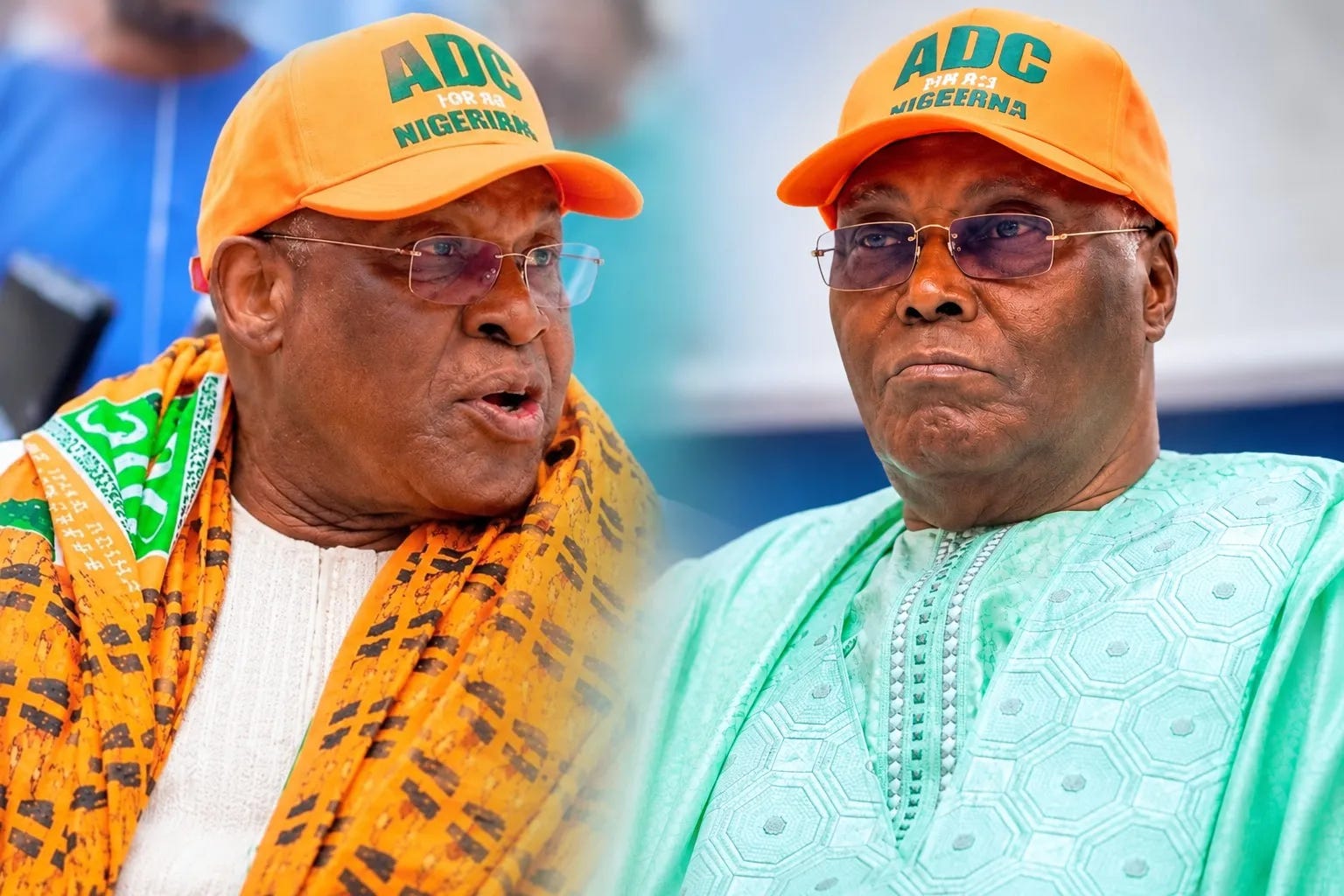
Atiku Abubakar has vowed to appeal the Federal High Court judgment that invalidated his nomination as the African Democratic Congress presidential candidate. His campaign council is preparing to seek a stay of execution of Thursday’s ruling, which also nullified the party’s David Mark-led leadership.
Atiku rejected the ruling and said his campaign would continue in Kebbi State following the launch in Sokoto. In a statement issued by Phrank Shaibu, Director of Strategic Communication, Atiku accused the All Progressives Congress of using court proceedings to derail his campaign. “The timing of this judgment is no coincidence,” he said. “It is part of a strategy to weaken my support in the North and frustrate a campaign whose message is resonating across the country”.
The judgment was delivered by Justice Peter Lifu in suit FHC/ABJ/CS/1819/2025, brought by Nafiu Bala Gombe, a former ADC National Deputy Chairman. Gombe challenged the emergence of David Mark and Rauf Aregbesola as national chairman and secretary, claiming he was entitled to succeed former chairman Ralph Nwosu. The court invalidated the Mark-led leadership and all decisions taken under it, including the nomination of candidates for the 2027 elections.
Atiku’s legal argument rests on a prior judgment. He says Justice Musa Liman of the Federal High Court delivered a ruling on 2 July 2026 in Suit No. FHC/ABJ/CS/1637/2025, affirming the legitimacy of the Mark-led leadership and directing INEC to recognise it. He argues that a court of coordinate jurisdiction cannot sit on appeal over another court of equal jurisdiction.
This mirrors the pattern of judicial interventions that have shaped Nigerian presidential contests since 2019. Courts have removed candidates, nullified primaries and ordered re-runs. The difference now is the timing. The judgment comes months before the 2027 election, with INEC already publishing Atiku’s name as the ADC candidate.
The campaign’s strategy is twofold. First, seek a stay of execution to suspend the judgment while the appeal proceeds. Second, argue that the judgment conflicts with an earlier ruling and should be set aside on jurisdictional grounds. Both are procedural. Neither addresses the substance of whether Atiku validly won the ADC primary.
The human stakes are about ballot access. If the judgment stands, Atiku is off the ballot. If the Court of Appeal stays it, he remains on the ballot pending the appeal. If the appeal succeeds, the judgment is overturned. Until one of those outcomes materialises, the ADC’s ticket exists in a legal limbo.
Winners and Losers
Winners: Atiku, who gains a legal pathway to challenge the judgment and a narrative of political persecution. Lawyers, who will earn fees through at least two more rounds of litigation.
Losers: The ADC, whose entire leadership and candidate slate are voided pending appeal. David Mark and the NWC, whose positions are suspended. Nigerian voters, who face uncertainty about who will appear on the ballot. The judiciary, whose credibility is tested by conflicting judgments from courts of coordinate jurisdiction.
Bottom Line: A stay of execution is a pause, not a victory. Atiku has vowed to fight. The Court of Appeal must decide whether the judgment stands or whether the earlier ruling prevails. Until it does, the ADC’s ticket is a legal argument, not an electoral fact.