


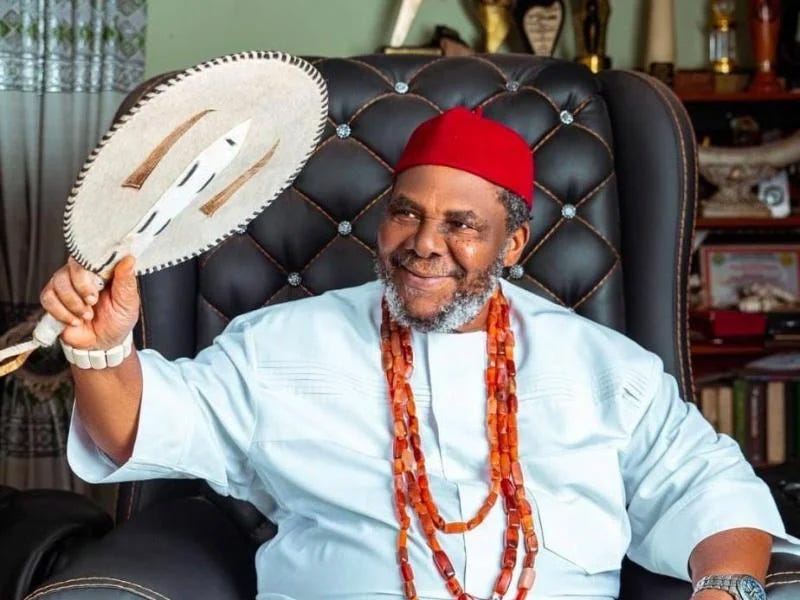
Pete Edochie died at 12:30 am on Wednesday in Enugu, his family announced in a statement titled “An Iroko Has Fallen.” He was 79. The cause was a prolonged battle with prostate cancer . He is survived by his wife, Josephine, and six children, including fellow actors Yul and Linc Edochie .
The mechanics of Edochie’s career are a map of how Nigerian entertainment professionalised. He began as a broadcaster in 1967 with the Eastern Nigerian Broadcasting Corporation, rising to Director of Programmes at the Anambra Broadcasting Service . The acting breakthrough came in 1987, when he played Okonkwo in the Nigerian Television Authority’s adaptation of Chinua Achebe’s Things Fall Apart. That role made him a national figure and gave Nollywood one of its founding archetypes: the commanding elder, the voice of authority, the man who spoke in proverbs and meant every one of them .
This echoes the 1990s video film boom, when actors like Edochie moved from television into a nascent industry that had no studios, no unions and no funding model. He appeared in more than 100 films, including Igodo, Rituals and Lionheart . The national honour of Member of the Order of the Niger came in 2003, and the industry awards followed .
Governor Peter Mbah of Enugu, where Edochie lived and died, called him “an institution” and noted that the loss came as the state hosts the National Festival of Arts and Culture . That timing is worth sitting with. A festival celebrating Nigerian heritage is now also a wake.
The winners are the streaming platforms and archives that will license his catalogue, and the meme accounts that turned his facial expressions into a second career for a generation that never watched his films. The losers are the actors who trained under his shadow and will now be measured against a standard that no longer walks among them, and the prostate cancer awareness advocates who will note that a man with access to the best care in Nigeria still died of a disease that kills silently when screening is neglected.
Bottom Line: A voice that defined Nigerian cinema has gone quiet, and the industry it built has not yet produced another one like it.