


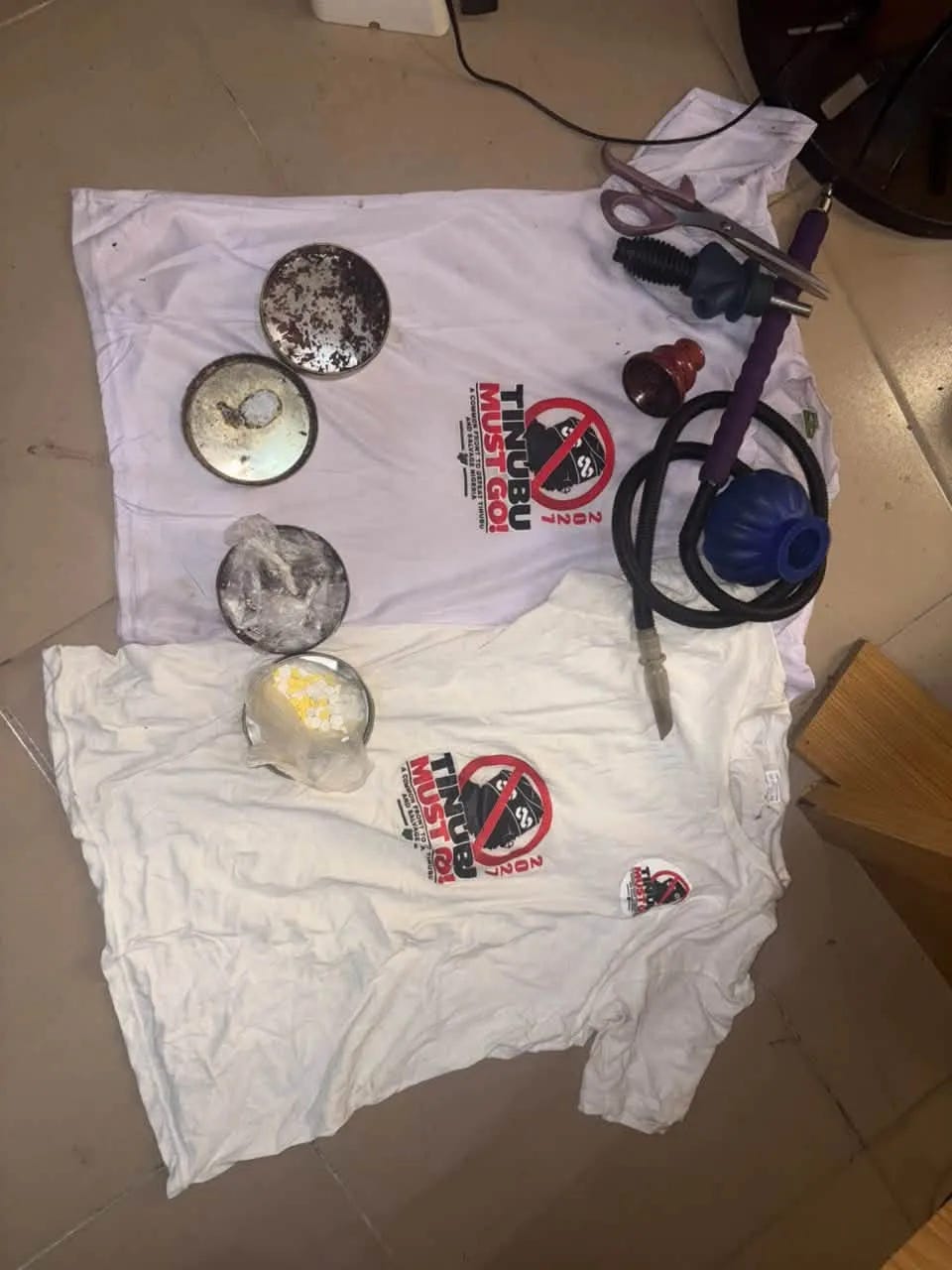
Five men are in a Maiduguri court. Their crime, according to the police, is not what they wore. It is what the police say they carried. Baba Aji Gremami, Mustapha Abba Yemen, Abacha Mohammed Ali, Adam Umar Gubio and Abdulhamid Mohammed were arrested on 25 September 2026 at about 6:00 pm. They wore T-shirts bearing the inscription “Tinubu Must Go.” Officers on a routine township patrol around the West End Roundabout stopped them. The police say the men engaged in conduct capable of causing a breach of public peace.
This is not the first time Nigerian authorities have arrested citizens over political T-shirts. In 2021, the Department of State Services arrested five persons wearing “Buhari Must Go” shirts at a church in Abuja. A Federal High Court ordered their release. In 2024, Amnesty International demanded the release of minors detained over the #EndBadGovernance protests. The pattern repeats. A political slogan is printed. An arrest follows. A drug allegation is added. The charge becomes criminal rather than political.
The Borno State Police Command denied that the motive of arrest was political. The Police Public Relations Officer, ASP Nahum Kenneth Daso, issued a statement. He said the Nigeria Police Force is a professional, non-partisan institution. It does not discriminate on the basis of political affiliation or viewpoint, he said.
The police listed the items recovered. Fifteen wraps of dried leaves suspected to be Indian hemp. One hundred tablets suspected to be D5. One shisha pot. A pair of scissors. And the two T-shirts bearing the “Tinubu Must Go” inscription. The suspects were charged with criminal conspiracy, inciting disturbance, disturbance of public peace and thuggery. The prosecution argued these offences run contrary to Sections 60, 78, 79 and 392 of the Borno State Penal Code. Their lawyers moved a bail application. The presiding judge adjourned the matter to 6 October 2026 for a ruling on bail. The substantive trial was slated for 26 October 2026.
Amnesty International rejected the drug allegation. The rights organisation described the explanation as an attempt to justify what it called unlawful detention. It accused the police of introducing a new narrative to justify the continued detention of the men. “Earlier, police accused the five men for alleged inciting disturbance, breach of public peace, and thuggery, and now linking them to drugs manifests a desperate attempt to punish them for their peaceful political activities,” Amnesty said.
The organisation said linking the five men to drugs and other crimes was a “familiar playbook” aimed at justifying political repression and undermining democratic freedoms. It demanded the immediate and unconditional release of the five men. It insisted that expressing a dissenting political opinion is not a criminal offence. “The five men must be released immediately and unconditionally. Holding and expressing dissenting political opinion is not a crime,” Amnesty said. It called on the Nigeria Police and the Borno State Government to end what it described as arbitrary arrests and detention of opposition members and supporters. It warned that continued arrests over peaceful political expression could further restrict civic space and freedom of expression in the state.
The men pleaded not guilty. The police maintain the suspects committed offences beyond merely wearing the T-shirts. The court will decide. The conflicting accounts will be tested. The bail ruling comes on 6 October. The trial follows on 26 October.
Winners: The police, if the drug charges hold in court. The Borno State Government, if the arrests deter dissent. Amnesty International, which gains a platform. Losers: The five men, who face prosecution and possible conviction. Their families. The right to peaceful political expression, which is contested. The Borno State Police Command, whose credibility is challenged. The Nigerian judiciary, which must resolve conflicting accounts. Citizens who now know that a T-shirt can lead to a drug charge.
Bottom Line: Five men wore T-shirts that said “Tinubu Must Go.” The police say they also carried drugs. Amnesty says the drug claim is a cover for political arrest. The court will decide on 6 October. A political slogan should not be a crime. If the drug charges are fabricated, the police have damaged their own credibility. If they are real, the men will face justice. Either way, Nigeria’s civic space is shrinking.