


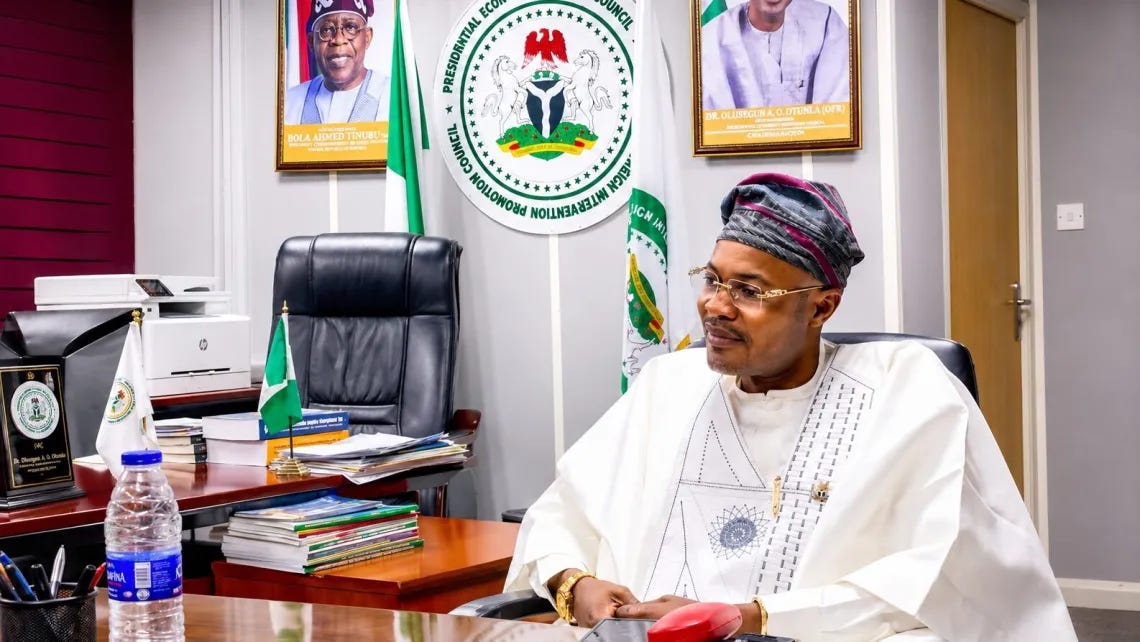
Adeniyi Adeyemi, the man accused of falsely parading himself as the Director-General of the illegal Presidential Foreign Intervention Promotion Council (PFIPC), created more fictitious government agencies and used forged legislative documents to open bank accounts in their names, Premium Times reported, citing an investigation by the Independent Corrupt Practices and Other Related Offences Commission (ICPC).
The ICPC said that apart from PFIPC, Mr Adeyemi also created the FCT Investment Promotion Agency (FIPA) and the Foreign Investment Promotion Agency and Public-Private Partnership (FIPA-PPP), using variants of the forged legislation he had previously relied on to present PFIPC as a legitimate federal government institution. He subsequently submitted the documents to Unity Bank to open two accounts for the fictitious agencies, according to the commission. The accounts were 0059761787 and 0059761718.
The discovery provides further insight into how Mr Adeyemi allegedly expanded the network of institutions he presented as government agencies after establishing PFIPC. Premium Times has reported how Mr Adeyemi gained access to government institutions and processes by presenting documents that purported to show that PFIPC had been created and recognised by the presidency.
The ICPC’s investigation followed President Bola Tinubu’s directive for a probe into PFIPC. In its interim report submitted to the President on 6 August, which Premium Times obtained, the commission said Mr Adeyemi was never appointed by the federal government and that PFIPC was not established by any law, executive order or other valid government instrument. The commission recommended his prosecution for alleged forgery, impersonation and related offences.
According to the ICPC report, Mr Adeyemi forged legislative instruments titled the Foreign Investment Promotion Agency and Public-Private Partnership Act (FIPA-PPP), Chapter N2117, Laws of the Federation of Nigeria, and the FCT Investment Promotion Agency Act. The commission said the two documents were variants of the same forged legislation previously used in relation to the Presidential Economic Advisory Council (PEAC) and PFIPC. The PEAC was established by former President Muhammadu Buhari to advise him on economic matters but has ceased to exist since he left office.
Using the forged documents, Mr Adeyemi allegedly presented the two organisations as federal government agencies and proceeded to open bank accounts in their names. The ICPC found that the account-opening documents reviewed by investigators did not contain the mandatory authorisation of the Office of the Accountant-General of the Federation, which is required for ministries, departments and agencies to operate accounts in commercial banks.
The instructions to open the accounts were purportedly issued by a person referred to as the chairman of the PEAC, Adekunle Ajayi, and a supposed secretary, identified in the documents as Lovina Akabueze. Mr Adeyemi was designated as Director-General and Chief Executive Officer and listed as the sole signatory to the accounts, the investigation found.
The ICPC recommended that the managing director, chief compliance officer and relationship or account officer responsible for the Unity Bank accounts be invited and interviewed, alongside relevant OAGF officials, Mr Ajayi and Ms Akabueze. It also recommended a broader analysis of bank accounts linked to Mr Adeyemi and other sources of funds he claimed to have obtained as loans.
The creation of the two fictitious agencies came amid Mr Adeyemi’s broader efforts to make PFIPC appear to be an established government institution. The ICPC said he wrote to several government agencies seeking collaboration and attempting to assume functions that fell within the mandates of existing institutions. Among other things, he sought involvement in the Federal Executive Council, collection of stamp duties and excess bank charges, processing of visas for foreign investors, collection of import duties, maritime revenue and temporary import permits. The commission said those requests encroached on the functions of the Nigerian Investment Promotion Council, the Nigeria Immigration Service, the Nigeria Revenue Service and the Nigerian Maritime Administration and Safety Agency.
Mr Adeyemi also attempted to organise a World Investment Summit. As part of that effort, he hosted members of the diplomatic community accredited to Nigeria and international investors at the Wells Carlton Hotel and Apartment in Abuja on 10 October 2025 for a pre-summit dinner. The event was organised without formal coordination with the Ministry of Foreign Affairs, according to the ICPC. The commission said N39 million was spent on the event: N2 million was paid for the venue, while N37 million went to catering. Braveicons Global Limited paid for the venue, while Queenlizzyking Supermarket, which the investigation linked to Mr Adeyemi, paid for the catering.
The event later became one of the developments that raised questions about PFIPC. On 16 October 2025, the Ministry of Foreign Affairs wrote to the Chief of Staff to the President and the National Security Adviser seeking clarification about Mr Adeyemi’s status following his engagement with members of the diplomatic community. The ministry became concerned after Mr Adeyemi approached it several times over the proposed World Investment Summit. The verification eventually unravelled the claims surrounding the organisation.
The ICPC investigation found that the collapse of PFIPC did not immediately end Mr Adeyemi’s efforts to organise the investment summit. After losing the PFIPC platform, he created what the commission described as the “World Investment Summit Group” and opened an account with Moore Money Microfinance Bank in the name of World Investment Summit. The account number was 9300696687. According to the investigation, the account received total inflows of N71.7 million. None of the funds came from a government source, the commission said. Even after the alleged scheme had been exposed and disrupted in October 2025, Mr Adeyemi continued using the World Investment Summit Group to correspond with members of the public.
The ICPC said that as recently as 5 June 2026, he authored letters in the name of the group using an address at Room 213, Second Floor, Phase III, Federal Ministry of Health, Federal Secretariat Complex, Abuja. The use of the address, the commission said, further created the impression that the organisation was a legitimate government entity.
The ICPC investigation concluded that PFIPC operated through a combination of misrepresentation, alleged forgery, compromised officials and administrative engagements that created the appearance of a recognised federal government institution. The commission said the case exposed weaknesses in verification procedures across some government institutions. Those weaknesses enabled the purported council to gain access to government processes, including budget consideration, office allocation, digital identity registration and engagement with diplomatic stakeholders.
On Friday, as part of his efforts to implement the ICPC’s recommendations, President Tinubu directed the Minister of Finance to lead a comprehensive forensic audit of federal government systems, including the Integrated Personnel and Payroll Information System, and the administrative and internal controls of federal agencies. The audit will scrutinise IPPIS and related payroll, personnel, pension and financial-management platforms, examining reported cases of ghost workers and payroll fraud. It will also cover all federal agencies, departments, commissions and parastatals, aiming to produce a definitive inventory of such bodies and verify their legal basis.
The discovery of the alleged PFIPC also led investigators to uncover another suspected fake agency, the National Brands Development and Made in Nigeria Special Project Office, which allegedly operated within the Office of the Secretary to the Government of the Federation. Premium Times reported how Mr Tinubu ordered the suspension of three permanent secretaries and the arrest of the agency’s alleged promoter, George Buchi Nwabueze.
The winners: the ICPC, which has uncovered the extent of the fraud; and the Nigerian public, who may see accountability. The losers: Mr Adeyemi, who faces prosecution; the government officials who enabled the fraud; and the Nigerian government, which faces another credibility crisis over the fake agencies.
Bottom Line: Adeyemi created multiple fake agencies, including FIPA and FIPA-PPP, and opened bank accounts for them using forged legislation. The ICPC has recommended his prosecution. The question is whether the government will act on the findings and prevent future fraud.