


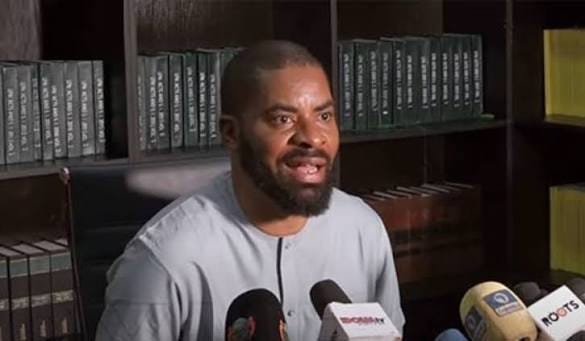
Human rights lawyer Deji Adeyanju has condemned Peter Obi’s recent appearances at churches, warning that the use of religion for political mobilisation could deepen divisions ahead of the 2027 elections. Adeyanju argued that elections should be centred on ideas, policies and competing visions rather than religious sentiments.
Adeyanju’s criticism follows Obi’s appearance at a Koinonia Global service in Abuja on Sunday, where the church’s founder, Apostle Joshua Selman, publicly acknowledged him before the congregation. Obi used the occasion to speak on governance, arguing that politicians were the problem with Nigeria and urging prayers for leaders to stop stealing public funds. The visit came after similar appearances at the Methodist Church Nigeria’s conference in Ibadan and a burial ceremony in Ebonyi State.
“Elections should be about ideas, policies and competing visions for Nigeria. Religion and politics should never be allowed to become instruments of division,” Adeyanju said. “The church is not a place for political campaigns or political gimmicks, and politicians are not pastors”.
Adeyanju cited the Electoral Act 2026, which expressly prohibits the use of places of worship for political campaigns and campaigning on religious, tribal or sectional grounds. Section 101 of the Act provides that anyone convicted could face fines between N3 million and N5 million, imprisonment for up to 12 months, or both.
The activist also condemned what he described as the gathering of religious clerics by a governor to endorse President Bola Tinubu. “The gathering of religious clerics by a governor last week to endorse Tinubu is also condemnable, just as it is troubling to see Peter Obi appearing to return to the same politics of religious mobilisation that divided Nigerians in 2023,” he said.
Reactions have been sharply divided. Obi’s supporters have highlighted double standards, pointing to the 2023 Muslim-Muslim ticket of Tinubu and Shettima, as well as President Tinubu’s recent meeting with hundreds of Christian clerics at Aso Rock. One X user wrote: “Peter attended a church service and was invited to speak. Nothing more and nothing less. Your good for nothing boss invited 500 clerics to Aso Rock a few days ago and you never uttered a word”.
Former presidential aide Bashir Ahmad, however, defended the criticism, arguing that Obi’s pattern of church visits represents political outreach dressed as religious engagement. “Let’s be honest here whenever an election draws near, we suddenly see Peter Obi on a seemingly endless church tour, week after week. If that isn’t political outreach dressed up as religious engagement, then what is?” he wrote.
The debate reflects a tension that has long trailed Nigerian democracy. Politicians routinely court worshippers in churches and mosques, seeking endorsements from influential clerics, even as the law discourages the practice . The 2023 election was widely read through a religious and ethnic lens, partly because the APC fielded a Muslim-Muslim ticket . Obi, then the Labour Party candidate, drew heavy support from southern and Christian voters and from the youth-led Obidient Movement .
The winners: the debate has focused attention on the role of religion in politics; and the Nigerian public, who are engaged in an important national conversation. The losers: Peter Obi, who faces renewed scrutiny over his church appearances; and the Nigerian political class, which continues to rely on identity-based mobilisation.
Bottom Line: Adeyanju has condemned Obi’s church visits as a return to 2023-style religious mobilisation. Obi’s supporters point to double standards. The debate is a sign of things to come as 2027 approaches.