


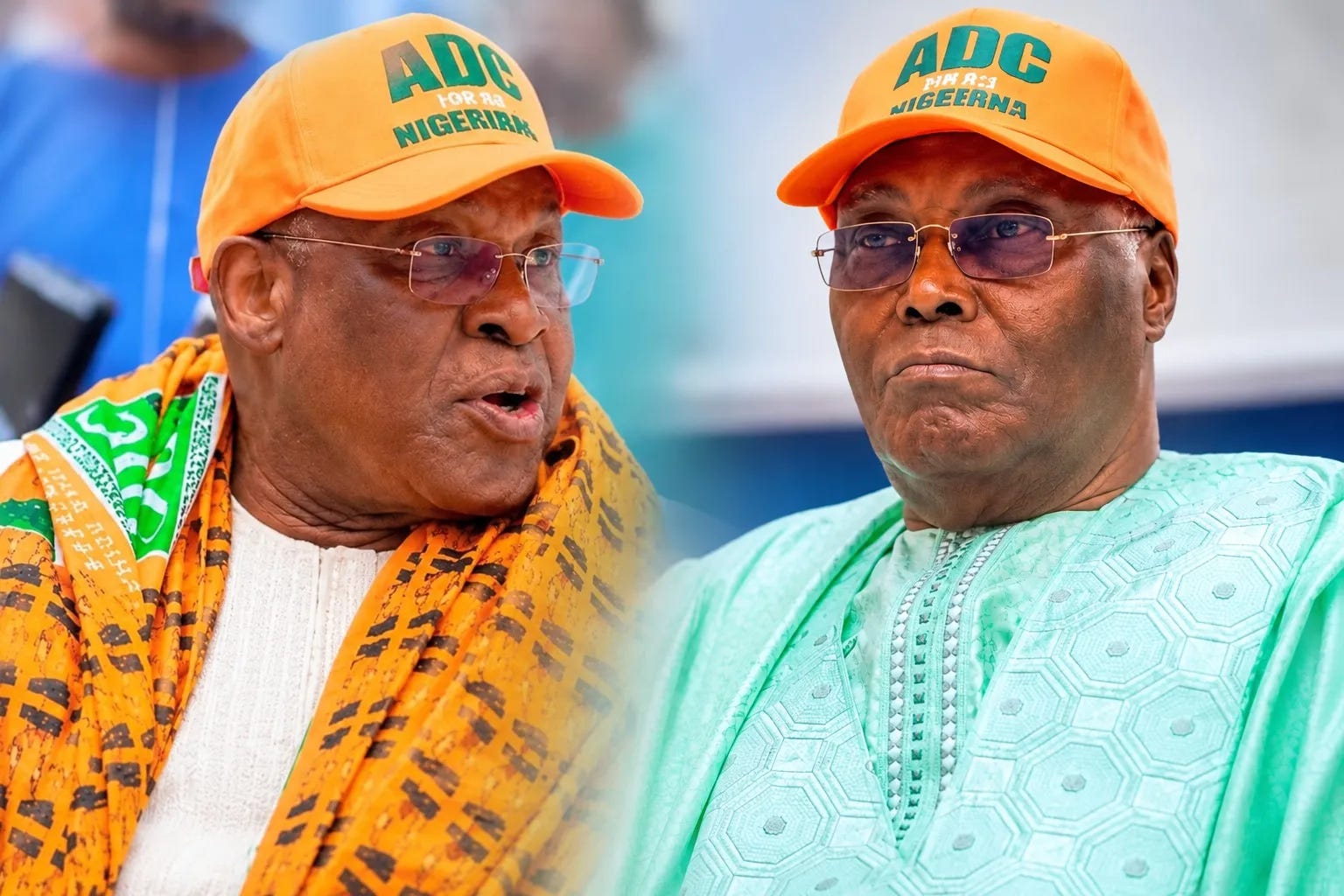
The African Democratic Congress has rejected a Federal High Court judgment that sacked its David Mark-led National Working Committee and invalidated Atiku Abubakar’s candidacy for the 2027 presidential election. The party said it will challenge the ruling at the Court of Appeal and petition the National Judicial Council.
Justice Peter Lifu delivered the judgment in Abuja on Thursday. The court declared the Mark-led caretaker committee illegal and voided all decisions taken under it, including the primary that produced Atiku as the party’s flag bearer. The court also held that the Independent National Electoral Commission should not recognise decisions taken at the party’s 99th National Executive Committee meeting of 27 July 2025.
The suit was filed by Nafiu Bala Gombe, a former ADC national deputy chairman, who challenged how Mark and others took control of the party. Atiku’s name had already been published by INEC as the ADC candidate. He had picked former Rivers State Governor Rotimi Amaechi as his running mate.
The ADC’s National Publicity Secretary, Bolaji Abdullahi, called the judgment another attempt to cripple the opposition. He questioned its timing, noting it came barely 24 hours after a large ADC campaign rally in Sokoto. “The Sokoto rally was simply a trigger that stampeded its delivery,” he said.
This mirrors the pattern of judicial interventions that have shaped Nigerian presidential contests since 2019, when the Supreme Court removed the APC’s candidates in Zamfara State over improper primaries. Courts have become the final arbiters of party nominations because the parties themselves cannot manage internal democracy. The difference now is the scale. A ruling that voids a party’s entire leadership structure also voids the nominations of thousands of candidates contesting local, state and federal seats.
The ADC’s legal objection rests on a prior judgment. It says Justice Musa Liman of the same Federal High Court delivered a ruling on 2 July 2026 in Suit No. FHC/ABJ/CS/1637/2025, affirming the legitimacy of the Mark-led NWC and directing INEC to recognise it. The party argues that a court of coordinate jurisdiction cannot sit on appeal over the judgment of another court of equal jurisdiction. “It is a settled principle of Nigerian jurisprudence,” Abdullahi said.
The party said it is awaiting the Certified True Copy of the judgment to establish its precise terms and orders. That caveat matters. Without the CTC, the ADC is responding to the headline outcome rather than the full reasoning of the court.
Atiku’s campaign issued a separate statement through Phrank Shaibu, Director of Strategic Communication. Atiku described the judgment as a calculated attempt to weaken his support in the North and frustrate a campaign whose message is resonating. “The ruling party’s greatest miscalculation is to assume that my support ends in the North,” he said. He urged supporters to remain calm and said the campaign train had moved to Kebbi.
The APC has consistently denied orchestrating judicial action against opposition parties. It has not issued a detailed response to the ADC’s specific allegations.
Winners and Losers
Winners: The Nafiu Bala Gombe faction, which gains legal validation of its challenge. The APC, which faces one less consolidated opposition structure if the judgment survives appeal. Lawyers, who will earn fees through at least two more rounds of litigation.
Losers: Atiku Abubakar, whose candidacy now depends on appellate judges. David Mark and the NWC, whose leadership is voided pending appeal. Thousands of ADC candidates whose nominations rest on the same primary process. Nigerian voters, who face another election cycle in which the ballot is shaped by courtrooms rather than campaigns.
Bottom Line: A court has removed a candidate. The party has rejected the ruling and will appeal. The test is whether the Court of Appeal addresses the coordinate jurisdiction argument, not just the political outcome. Until it does, the ADC’s ticket exists on paper and in litigation.