


Access Holdings has completed the sale of a 7.44% stake in Access Bank Ghana, trimming its holding from 93.40% to 85.96%. The transaction, which went through the Ghana Stock Exchange on 15 July, attracted pension funds, institutional investors and high-net-worth individuals. The corporate disclosure, signed by Company Secretary Helen De Cardi Nelson, stated that the sale reflected continued investor interest and confidence in the bank’s long-term prospects.
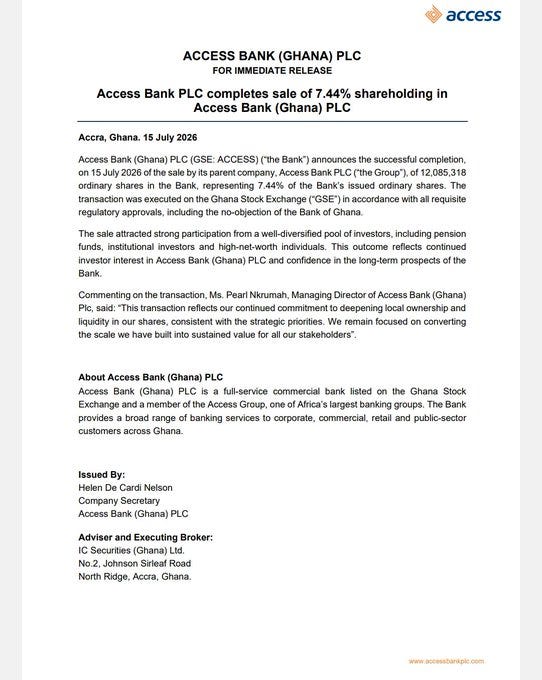
But the move is not about confidence. It is about compliance. The Central Bank of Nigeria’s revised HoldCo framework restricts banks’ overseas investments to 10% of total shareholders’ funds. Access Holdings needed to trim its exposure. Ghana was the logical unit to sell. Head of Research at GTI Limited, Abiodun Ogunniyi, described the move as “inevitable”. “Similar moves might come from UBA and probably also GTCO, given that those are our banks with the most overseas investments,” he noted.
The transaction is a strategic capital optimisation exercise, not a withdrawal from Ghana. Chief Blakey Ijezie, founder of Okwudili Ijezie & Co, argued that Access retains a strategic presence in Ghana while freeing up proceeds for technology, capital strengthening, and expansion elsewhere on the continent. Access’s UK operation has now overtaken Nigeria in profitability, making the group’s earnings more diversified.
This is the first major divestment under the CBN’s new HoldCo framework, which was introduced to curb capital flight and ensure that Nigerian banks maintain sufficient capital at home. The last time Nigerian banks were forced to trim overseas operations was during the 2016 currency crisis, when the CBN restricted foreign currency exposures. The difference is that today’s move is regulatory, not reactive. The CBN is asserting control over the banks’ international ambitions. The banks are complying. But the cost of compliance is a reduced presence in a growing West African market.
Winners: Access Holdings (which strengthens its capital position), the CBN (which enforces its rule), pension funds and institutional investors (who acquire shares in a profitable bank).
Losers: Access Bank Ghana (which loses some parental support), Nigerian banks with overseas ambitions (who face tighter constraints).
Bottom Line: Access’s sale is a reminder that Nigerian banks are now more tightly tethered to home — and that has consequences for their pan-African ambitions.