


Toluwalase Adeyemi finishes a full day of code refactoring in under three hours. He is 26. He works from a co-working space in Yaba, Lagos. Tasks that once took manual debugging and endless documentation reviews are now drafted, audited and optimised in minutes. He uses conversational AI models. His experience is no longer unusual. It is becoming the baseline expectation of modern employment in Nigeria.
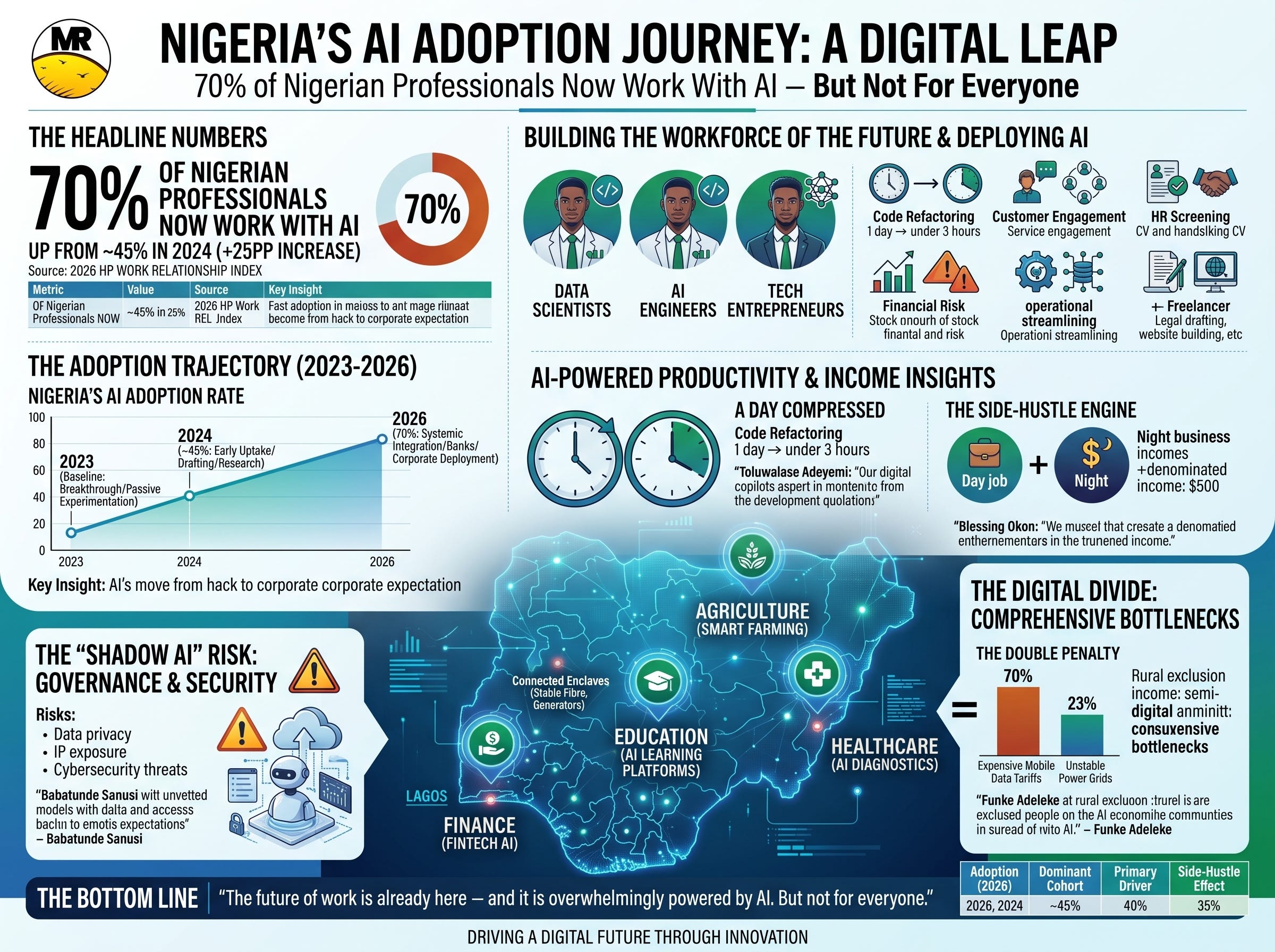
Generative AI platforms broke through globally in early 2023. ChatGPT, Claude and specialised coding assistants followed. Nigerian workers moved quickly from experimentation to daily use. By 2024, about 45% of formal-sector workers used AI tools for research, drafting, data analysis and customer response. Two years later, adoption has become systemic. Tier-one banks, consultancies, law firms and creative agencies in Lagos, Abuja and Port Harcourt now deploy custom AI agents. They use them to streamline workflows, assess risk and automate customer engagement.
The index
The 2026 HP Work Relationship Index surveyed professionals across multiple countries. It measures the relationship between employees, productivity and workplace technology. In Nigeria, 70% of respondents actively embrace AI integration in daily office operations. That places Nigeria among the world’s most enthusiastic adopters. The driver is a young, tech-literate workforce. It is also economic pressure.
Why workers adopt
Dr Chisom Eze is a Senior Research Fellow in Digital Economy at Pan-Atlantic University. She spoke on 1 October 2026. She said Nigerian professionals view technology through a pragmatic lens. Corporate staffing is lean. Inflation is high. Performance targets are intense. AI tools are not novelties to them. They are productivity multipliers. She said the rise from 45% in 2024 to 70% in 2026 shows a survival mechanism. Workers use automated tools to execute multi-person workloads in a fraction of the time. That keeps them competitive.
The demographic composition matters. Gen Z and Millennials make up most of Nigeria’s white-collar workforce. They absorb new platforms quickly. Mature markets face legacy processes and employee scepticism. Younger Nigerian professionals have integrated AI into their professional identities. The index shows they report higher career satisfaction and agency when equipped with AI. They use it to eliminate repetitive drudgery. They free mental bandwidth for strategic thinking, creative problem-solving and professional development.
Adeyemi described how the tools changed his week. Routine tasks like writing unit tests, generating API documentation or summarising client briefs used to consume more than half of it. He now delegates those tasks to AI prompts. He focuses on software architecture and product strategy. He said younger professionals do not see AI as a threat to job security. They see it as a digital copilot that raises output quality and speeds career progression.
The side-hustle economy
The index highlights a distinctly Nigerian dimension. AI has accelerated the digital side-hustle economy. Living costs are high. The naira has weakened. Millions of professionals run secondary income streams. They freelance, consult, market and build micro-businesses. AI tools lower the cost of entry. They reduce overhead. Marketing copy, social media assets, legal drafts and basic web applications can now be produced by one person. Solo operators deliver agency-level output to domestic and international clients.
Blessing Okon is an HR Consultant and independent strategy advisor in Abuja. She spoke on 3 October 2026. She manages a full-time corporate role and a thriving talent advisory practice. She uses AI platforms to screen resumes, draft candidate reports and build training modules after hours. She said scaling a solo business alongside a demanding primary job would be physically impossible without automated tools. For many young Nigerians, AI is not just an employer-provided tool. It is the engine of their personal financial resilience and their dollar-denominated side income.
The risks
Enthusiasm has introduced workplace tension. Younger employees embrace adoption. Corporate boards and risk officers worry about data privacy, intellectual property exposure and governance gaps. Employees feed confidential financial records, client data and legal documents into public AI models. That creates cybersecurity exposure. Beneath the optimism sits a quiet fear among mid-level administrative staff. Algorithms are becoming capable of cognitive tasks. Displacement feels possible.
Mr Babatunde Sanusi is Vice President of Human Resources at a leading commercial bank in Victoria Island. He spoke on 4 October 2026. He said institutions must set ethical frameworks without stifling innovation. His bank encourages AI use for efficiency. But unmonitored “shadow AI” poses an unacceptable risk. He said policy must focus on upskilling workers to become effective AI managers, not replacing them. Companies without structured guidelines risk data breaches and alienated staff.
The infrastructure wall
AI in Nigeria runs into physical limits. Cloud platforms need reliable power and affordable high-speed internet. Both remain scarce or expensive for millions. Professionals in Lagos Island, Ikeja or the Abuja Central Business District work with stable fibre and generator-backed offices. Workers in rural and semi-urban communities face connectivity bottlenecks. Mobile data tariffs are high. Streaming bandwidth-heavy AI applications is a financial burden for lower-income workers.
Engr Funke Adeleke is a Telecommunications and Digital Infrastructure Specialist. She spoke on 4 October 2026. She warned against celebrating national adoption metrics without addressing the digital divide. The 70% figure reflects samples drawn heavily from urban white-collar environments. Rural professionals are functionally excluded. Running AI sessions on expensive data while relying on unstable power creates a double penalty. She argued that unless operators and federal authorities expand affordable broadband and stabilise generation, AI will concentrate advantage within a small urban elite. It will compound existing inequality.
Winners and Losers
Winners: Tech-literate professionals, who gain productivity and higher earnings. Young workers, who gain agency and career progression. Employers, who gain efficiency from smaller teams. Solo entrepreneurs, who gain agency-level capability. AI tool providers, which gain users. Consultancies and banks, which automate workflows.
Losers: Mid-level administrative staff, who face displacement risk. Workers without reliable power or affordable data. Rural professionals, who are excluded. Organisations that fail to set governance rules, which face data breaches. Workers who feed confidential data into unvetted models. The digitally excluded, who fall further behind. Nigeria’s labour market, which risks concentrating gains among an urban minority.
Bottom Line
Nigerian professionals are not passive consumers of global technology. They are active integrators. AI has moved from novelty to engine. It powers productivity, side income and ambition. But the 70% figure hides a divide. Urban white-collar workers gain. Rural workers are locked out. Corporate boards must govern use without killing innovation. Government must expand broadband and fix power. Without that, AI will widen inequality rather than reduce it. The future of work is here. Not everyone can reach it.