


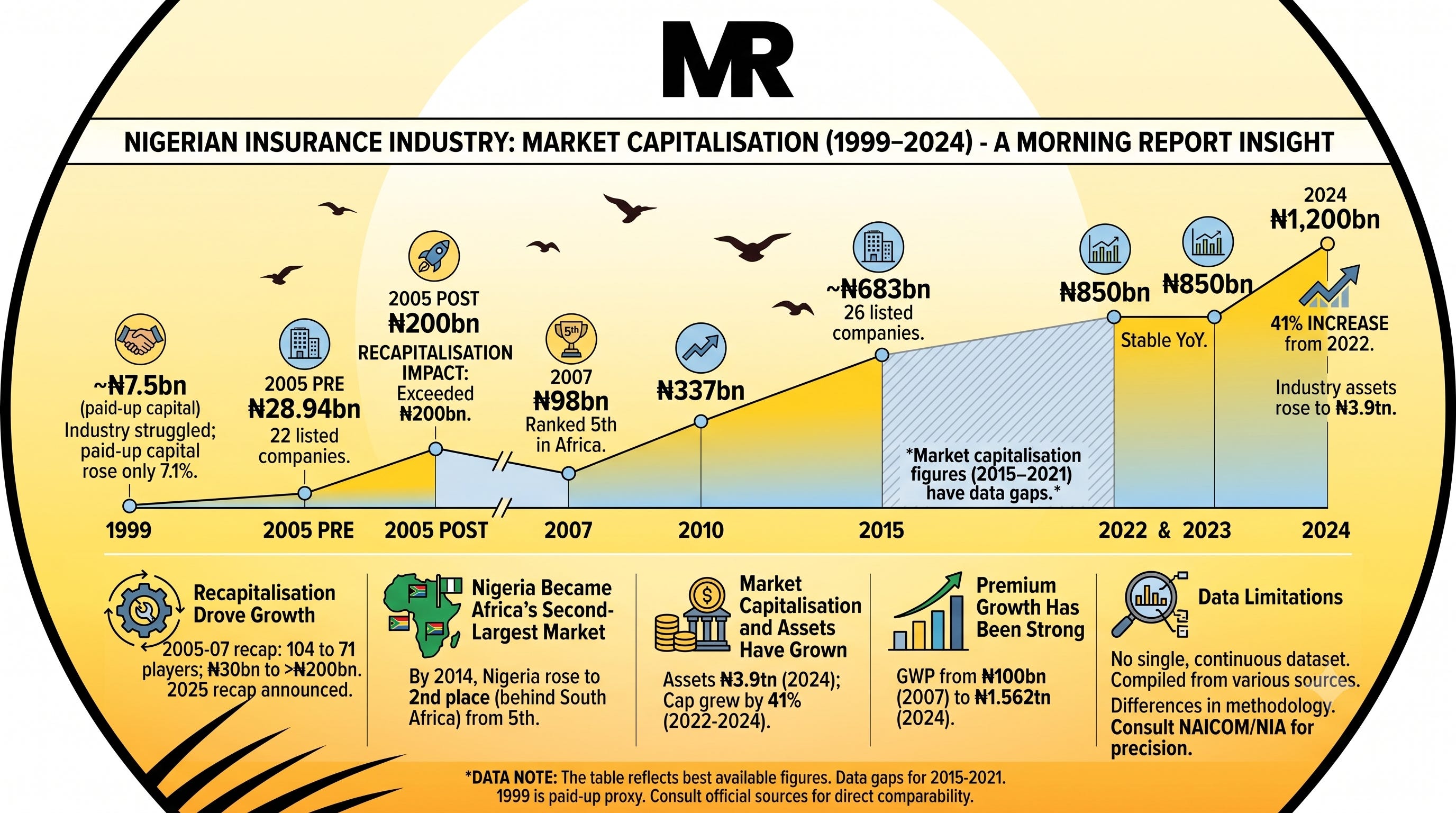
Nigeria’s insurance industry has completed a year-long recapitalisation programme, with 43 insurance and reinsurance companies meeting the new minimum capital requirements. The exercise has injected over ₦300 billion in fresh capital into the sector. The successful companies include 23 non-life insurers, 10 life insurers, 8 composite insurers and 2 reinsurance companies, marking a major milestone in strengthening the sector’s financial capacity, improving risk underwriting and enabling operators to take on larger-ticket business.
The National Insurance Commission (NAICOM), confirming the results at the weekend, stated that the successful firms have met the minimum capital requirements set under the 2025 Nigeria Insurance Industry Reform Act (NIIRA) and other applicable insurance laws and guidelines. The commission noted that eight insurance companies submitted compliance certificates shortly before the statutory deadline and are currently undergoing final verification and regulatory review, a process expected to be completed within 14 days.
NAICOM Commissioner Olusegun Ayo Omosehin said the recapitalisation exercise was successfully completed under Section 15 of the NIIRA 2025, signed into law by President Bola Tinubu on 31 July 2025 as part of the government’s financial sector transformation agenda. “The successful completion of this exercise marks a significant milestone in the transformation of Nigeria’s insurance industry and signals the beginning of a new era for insurance in the country,” Omosehin said.
Among the companies that met the requirements are composite insurers like Leadway Assurance, AIICO, Cornerstone, AXA Mansard, LASACO, Fortis Global, Industrial and General, and Great Nigeria. Non-life insurers include Zenith General, Custodian and Allied, NEM, Heirs General, and Mutual Benefits, among others. Life insurers include Custodian Life, CHI Life, Heirs Life, Prudential Zenith Life, and Stanbic IBTC. Reinsurance companies that scaled the hurdle are Continental Reinsurance and FBS Reinsurance.
The recapitalisation programme, which began after the enactment of NIIRA 2025, was structured to provide strategic oversight and ensure transparency throughout the transition. The commission issued detailed guidelines on the implementation of the Minimum Capital Requirements to ensure an orderly and verifiable process.
This echoes the 2005 banking consolidation, which also saw a wave of mergers and acquisitions as banks scrambled to meet new capital thresholds. The mechanism then was different, but the result was the same: a stronger, more resilient financial sector.
The winners: the 43 insurers that met the requirements, which are now better capitalised and positioned to take on larger risks; the Nigerian public, who benefit from a stronger insurance sector; and NAICOM, which has successfully overseen the recapitalisation. The losers: the eight insurers still awaiting verification, which face an uncertain future; and the Nigerian economy, which could suffer if any of those firms fail.
Bottom Line: 43 insurers have survived the recapitalisation. Eight are still waiting. The sector is stronger. The question is whether the remaining eight will survive or collapse.