


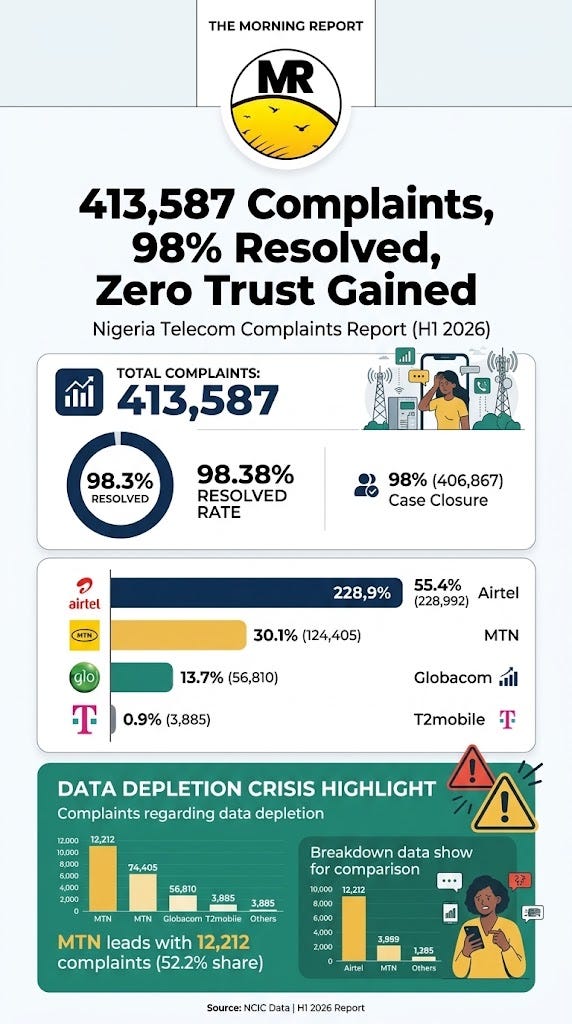
The notification arrives without warning. A data bundle bought hours earlier is gone. The screen shows zero megabytes. The subscriber has not streamed a film. They have not downloaded a file. They have scrolled, messaged and maybe watched a few short videos. For millions of Nigerians, this is a daily experience. The Nigerian Communications Commission (NCC) has now put a number to the frustration. Mobile operators received 413,587 formal complaints in the first half of 2026.
Historical background: Nigeria’s telecom revolution began with the 2001 GSM licence auctions. Active lines climbed from under a million to over 200 million in two decades. That expansion was one of the fastest in the world. Regulation lagged behind it. Consumers bore the cost. The NCC introduced the Consumer Code of Practice in 2018. It followed with the Quality of Service Business Rules in 2024. Both set binding standards and resolution timelines. Enforcement has been uneven. The bi-annual complaint disclosures are now the regulator’s main transparency tool. They also reveal how far the market is from seamless service.
The complaint data
Operators resolved 406,938 complaints. That is a 98.38% resolution rate. The figure looks triumphant. It is not. Resolution rates measure paperwork, not satisfaction. Airtel recorded 228,992 complaints, the largest share. MTN followed with 124,405. Globacom recorded 56,810. T2mobile, formerly 9mobile, recorded 3,885.
Resolution efficiency varied. Airtel closed 99.38% of its cases. Globacom resolved 99.04%. MTN recorded 96.57%. T2mobile lagged at 88.57%.
Dr Aminu Maida, the NCC’s Executive Vice Chairman, addressed the figures in Abuja on 22 September 2026. He said publishing raw operational data empowers consumers and disciplines operators. He acknowledged that the high resolution rate reflects better customer care. He also said the elevated baseline volume shows operators must address root technical causes before grievances become complaints.
The data depletion flashpoint
Data depletion is the centre of subscriber anger. Between January and June, the top three networks received 23,391 complaints about unexplained data usage. MTN led with 12,212. Airtel followed with 9,806. Globacom recorded 1,373. T2mobile recorded five.
MTN crossed 100 million active subscribers in July 2026. As the market leader grows, scrutiny intensifies. Subscribers report bundles vanishing within hours. Online platforms and service centres have become venues for accusation. Phantom billing. Manipulative metering. MTN rejects the claims.
Karl Toriola, MTN Nigeria’s Chief Executive Officer, defended the company’s billing integrity at an industry engagement in Lagos on 25 September 2026. He said modern applications consume more bandwidth than users realise. High-definition streaming, automatic video playback, cloud backups, software updates and app synchronisation drain gigabytes quickly. He said MTN has deployed daily usage notifications and interactive data calculators. He said the metering engines are audited and calibrated to international standards.
The consumer advocate’s counter
Prince Deolu Ogunbanjo, President of the National Association of Telecoms Subscribers (NATCOMS), rejected the narrative of regulatory success. He spoke in Lagos on 24 September 2026. He said high resolution percentages mask repetitive, unresolved faults. Subscribers call customer care for the same issues. Chiefly rapid data depletion and uncredited recharge transactions. A complaint marked resolved often recurs within 48 hours. He said arbitrary deductions and fleeting data balances feel like systematic exploitation, not minor glitches. He called on the regulator to impose heavy financial sanctions rather than merely publish statistics.
The operator’s defence
Industry bodies point to operating conditions. Engr Gbenga Adebayo, Chairman of the Association of Licensed Telecoms Operators of Nigeria (ALTON), spoke on 26 September 2026. He said fibre-optic cable cuts from road construction, diesel price inflation for off-grid towers and site vandalism force networks to reroute traffic. That causes latency spikes and packet losses. Those distortions affect data session monitoring. He said maintaining high-speed broadband across thousands of kilometres of hostile terrain requires capital expenditure rarely reflected in end-user tariffs.
The argument has merit. Nigeria’s operating environment is difficult. Power is unreliable. Security is uneven. Right-of-way issues slow fibre deployment. Operators face real costs. Those costs do not explain every vanishing gigabyte.
The lived reality
Technical explanations provide little comfort to those who depend on connectivity. Chisom Nwachukwu is a Lagos-based digital content creator. She spoke on 27 September 2026. She said a 20-gigabyte bundle bought for video uploads and client communication vanishes within two days. She turns off background refresh. She limits active usage. It does not help. She said when the network is slow and buffering, watching the balance drain feels unjust. Subscribers pay premium prices for degraded service while operators hide behind technical language, she said.
Her experience is common. Freelancers, traders, students and remote workers rely on data. When it disappears, income disappears with it. The emotional weight has grown since the NCC approved tariff increases. Subscribers now pay more for every gigabyte. The sting of a dwindling balance is sharper.
The trust problem
The gap between how operators measure consumption and how subscribers experience it is a trust problem. A subscriber who sees slow speeds and a falling balance cannot reconcile the two. The regulator’s technical explanations do not resolve the contradiction. The operator’s audits do not satisfy the customer. The resolution rate does not restore confidence.
The NCC faces a harder task than tallying complaints. It must enforce quality of service. That means verifying metering systems independently. It means penalising operators when service falls below standards. It means publishing enforcement actions, not just complaint statistics. The regulator has the rules. It needs to use them.
Winners: The NCC, which publishes data. Airtel, which resolves complaints fastest. Operators with transparent tools. ALTON, which frames the operating environment. Losers: Subscribers, who pay more for uncertain value. MTN, whose data practices face the most scrutiny. T2mobile, whose resolution rate lags. Content creators and small businesses, who lose income when data vanishes. The sector, which loses trust with every unexplained depletion.
Bottom Line
Four hundred thousand complaints in six months. A 98% resolution rate means little when the same problems return. Nigeria’s next telecom challenge is not getting more people online. It is keeping those already online convinced the service is worth paying for. Data is now as essential as electricity. The regulator must move from counting complaints to enforcing quality. Until subscribers trust the meter, the complaints will keep coming.