


The Lagos State Government announced 33,009 domestic and sexual violence cases between September 2021 and July 2026. The Attorney-General, Lawal Pedro, presented the figures at a media parley on Monday. Domestic violence accounted for 13,515 cases. The agency also recorded 1,171 defilement cases and 420 rape cases. Reported cases rose steadily from 5,929 in 2022 to 7,882 in 2024 before declining to 7,721 in 2025. The government claims a 23.6 per cent decline. The executive secretary cautioned against interpreting fewer reports as a decline in violence.
This caution is the most honest thing said at the briefing. Fewer reports do not mean fewer assaults. They mean fewer people believe the system works for them. This mirrors the gap between crime statistics and actual incidence during the 2015–2016 recession, when Lagos police recorded a 17 per cent drop in robbery reports while hospital emergency admissions told a different story.
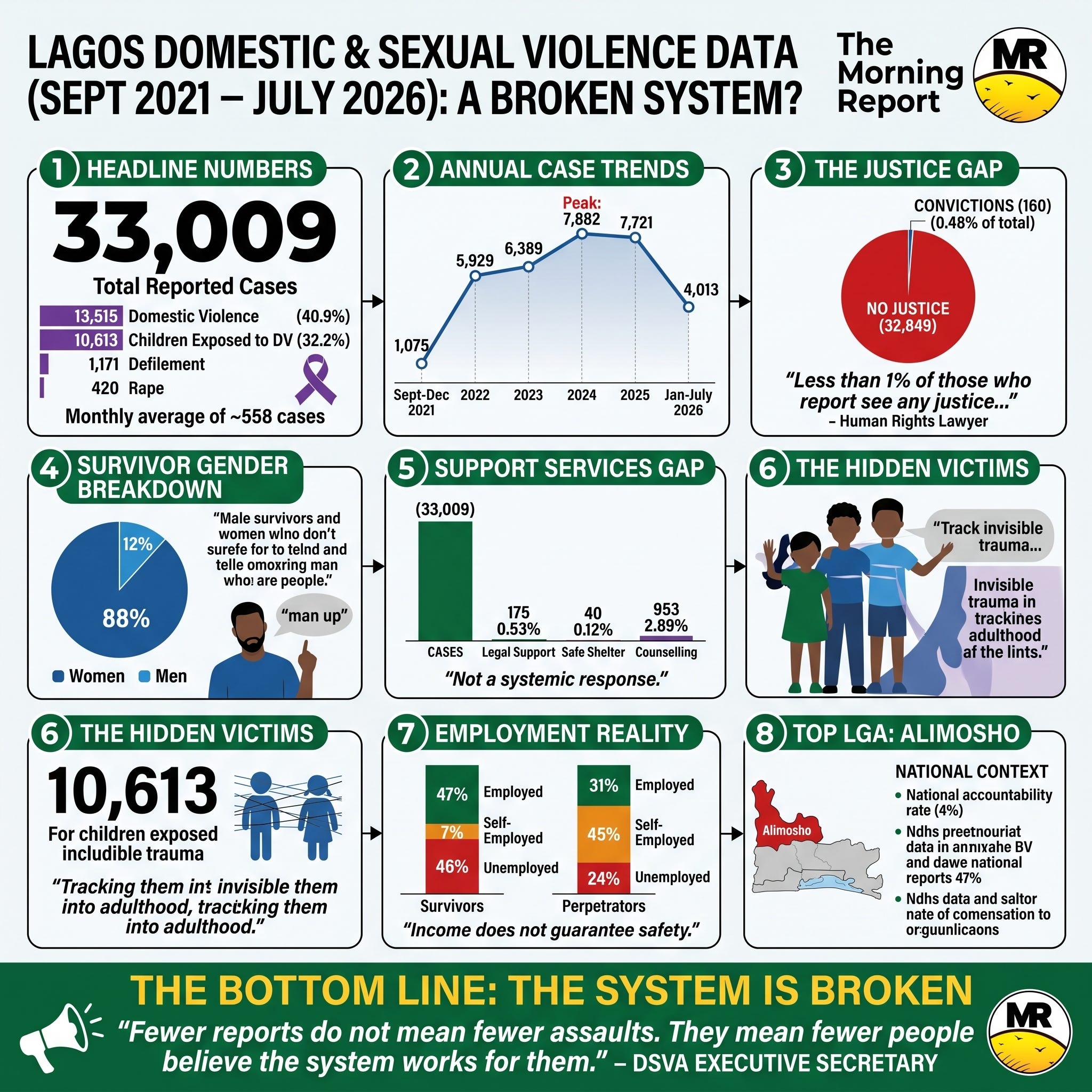
The data also reveals a critical oversight. Women constitute 88 per cent of reporters. Men represent 12 per cent. This matches a pattern seen in the national Violence Against Persons Prohibition Act reporting: male survivors rarely come forward. One Lagos-based gender rights advocate told this reporter that the system is not built for them. ‘From the first point of contact at the police station to the counselling rooms at the DSVA, everything is designed with a female survivor in mind. Men are told to “man up” or simply do not see themselves in the posters,’ she said. This is not a partisan political dispute. It is a structural blind spot.
The state secured more than 160 convictions. That represents about 0.5 per cent of reported cases. For every survivor who walks through the DSVA doors, 199 others see no justice. A Lagos-based human rights lawyer argued that the focus on securing these convictions is insufficient. ‘The government is counting 160 convictions as a victory, but you have 33,009 reported cases. If less than one per cent of those who report see any justice, what does that say to the other 99 per cent? It tells them that reporting is a gamble they cannot afford to lose,’ he said.
The government’s investments must be measured against this gap. Free legal support reached only 175 survivors. Safe shelters accommodated 40 survivors. The agency provided counselling to 953 survivors. While these numbers are not zero, they are negligible relative to the scale of reported need. When a public agency receives 300 new clients monthly, offering psychological support to 953 survivors over five years is not a systemic response.
A civil society organisation director who works directly with survivors of gender-based violence described the systemic barriers more bluntly. ‘A woman living in a one-room apartment in Alimosho, which we now know had the highest reports of adult cases, cannot wait for a public defender when she needs to feed her children,’ she said. ‘The law exists. The agency exists. But the practical infrastructure for a poor woman to access protection does not exist in any meaningful way.’ She argued that the government cannot claim a shift from crisis response to prevention while survivors wait months for prosecutions that end in acquittals.
The Attorney-General also challenged the tendency to link violence solely to unemployment. The data shows that 47 per cent of survivors were employed and seven per cent self-employed. Among perpetrators, 31 per cent were employed and 45 per cent self-employed. This is an important corrective. For years, public discourse has reduced domestic violence to an economic problem. The figures prove that income does not guarantee safety. It also proves that the crisis is more complex than poverty alone. But the government did not offer a comprehensive explanation for what is driving the violence. The briefing gave numbers without theory.
A Lagos State University sociologist pointed to the historical weight of colonial-era family law. ‘In many parts of Lagos, the customary courts still operate with a framework that treats domestic violence as a private family matter rather than a criminal offence. The state can pass all the policies it wants, but the frontline institutions that women encounter are still operating with a 1960s mindset,’ he said. The challenge is not just building shelters but changing the default response of the courts and the police. That has been the slowest part of the reform.
Then there is the hidden violence against children. The DSVA identified 10,613 children who suffered emotional abuse from exposure to domestic violence. These children are not counted among the 13,515 adult domestic violence reports. They are a secondary casualty class. A child protection expert with whom this reporter spoke described the long-term costs. ‘These children are not just witnesses. They are trauma carriers. The state is investing in shelters and counselling for adult survivors, but we are not tracking what happens to these 10,000 children when they become adults,’ she said. ‘We are treating the symptom and ignoring the generational transmission of the disease.’
This case is also a test of institutional credibility. The government is asking survivors to trust the system. Yet the response ratio suggests the system cannot handle the volume. A mid-level official at the Lagos Ministry of Justice, speaking on condition of anonymity, admitted that resources are stretched thin. ‘We have the political will at the top, but the budget for prosecution and witness protection is not enough. We are overworked and under-resourced. The public sees convictions, but they do not see the cases we cannot even file because we do not have the personnel,’ he said.
The Winners: The Lagos State Domestic and Sexual Violence Agency receives renewed visibility. Attorney-General Lawal Pedro delivers a media-friendly data story. Civil society organisations gain new ammunition for advocacy. The Losers: The 99.5 per cent of survivors without convictions. The 10,613 children who witnessed violence. Male survivors in the 12 per cent reporting category who lack gendered support. Taxpayers who fund a system that processes fewer than 200 successful prosecutions out of 33,000 reports.
Bottom Line: The Lagos DSVA has built a reporting machine. It has not yet built a justice machine. Until the government closes the gap between report and redress, the 33,009 figure is a measure of failure, not progress.