


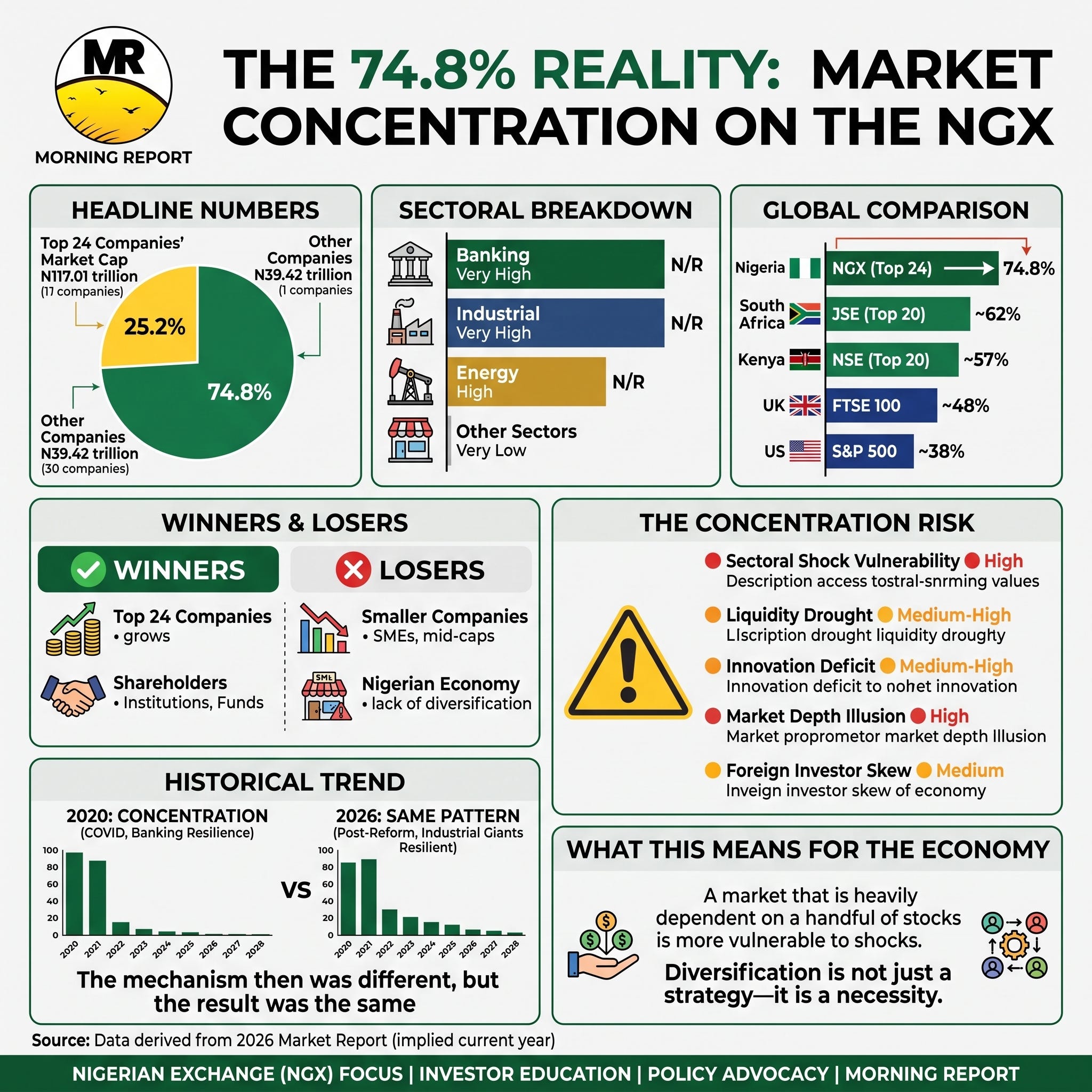
When we look at the flashing green and red tickers of the Nigerian Exchange (NGX), we see a funhouse mirror reflecting a highly distorted version of the national economy. Recent capital market data has laid bare a staggering reality: just 24 top-tier companies across the banking, industrial, and energy sectors now account for a massive 74.8% (₦117.01 trillion) of the NGX's total market capitalisation. This immense concentration of market value in a remarkably small number of corporate giants highlights the overwhelming, almost suffocating dominance of these three specific sectors.
While the headline numbers often paint a picture of a robust, bull-charging market, the exchange's structural foundation is unnervingly narrow. A market heavily dependent on a handful of stocks is far more vulnerable to sudden macroeconomic shocks. The dominance of the banking, industrial and energy sectors reflects the legacy structure of the Nigerian economy, an economy still heavily reliant on traditional rent-seeking sectors, large-scale manufacturing monopolies and fossil fuels, while modern, diversified growth engines struggle to find a foothold on the exchange. This dynamic strongly echoes the market concentration trends witnessed in 2020, when a select few companies dominated the NGX. The economy's underlying mechanisms may have subtly shifted since then, but the result remains the same: a capital market that is dangerously top-heavy.
The Vulnerability of a Heavyweight Market
The inherent danger of this concentration is that the Nigerian equities market is effectively held hostage by the daily performance of these 24 companies. When these giants sneeze, the entire exchange catches a violent cold. The illusion of a broad-based market rally is frequently shattered by the price movements of just one or two mega-cap stocks.
This vulnerability was laid bare just days ago. Analysts at Maven Asset Management warned on August 11 that while the market occasionally shows selective bullish momentum, a sudden decline in a single heavyweight can completely distort the day’s outlook. They pointed out that a massive ₦40 drop in the share price of MTN Nigeria, one of the NGX’s premier market-capitalisation stocks, indicated highly significant selling pressure that easily overwhelmed positive movements in smaller sectors.
This fragility was echoed just three days later by market analysts at Investdata Consulting. On August 14, they observed that the entire Nigerian bourse ended the trading week on a noticeably weaker footing, driven almost entirely by renewed profit-taking in a handful of large-cap stocks. The analysts highlighted that selling pressure was heavily concentrated in selected heavyweight equities across the banking and consumer goods sectors, specifically pointing out that declines in influential stocks like Dangote Sugar, Ecobank Transnational Incorporated and Nigerian Breweries exerted massive downward pressure on the benchmark index. When a market’s entire trajectory can be dictated by the quarterly earnings or temporary sell-offs of just half a dozen companies, it ceases to be a diverse barometer of economic health and instead becomes a tracking index for the elite.
The Retail Trap and the Illusion of Liquidity
For the average retail investor, navigating this top-heavy market is akin to swimming in the wake of a supertanker. The concentration of capital in the top 24 companies leaves most smaller listed companies starved of liquidity and investor attention. These smaller entities struggle to attract the investment needed to scale operations, hire more workers, and contribute meaningfully to the real economy.
When investor focus is hyper-fixated on the dominant banking and industrial players, trading volumes for mid-to-small cap stocks dry up entirely. David Adonri, a prominent capital market analyst, articulated this exact crisis on August 11 while discussing the plight of investors trapped in illiquid stocks. He noted that in these forgotten corners of the market, sell orders are heavily concentrated against weak demand. Adonri explained that this dynamic suggests shareholders are desperate to sell their holdings at the quoted prices, but they simply cannot execute the trades because there are no prospective buyers. Outside the top 24 companies, the market is often a ghost town, proving that a concentrated exchange is fundamentally illiquid for most participants.
The Disconnect from the Real Economy
Perhaps the most troubling aspect of this market concentration is what it represents off the trading floor. The 24 companies dominating the NGX are generating record profits and delivering massive capital gains to their shareholders, yet these financial victories rarely trickle down to the streets of Lagos, Kano or Port Harcourt. The stock market is aggressively minting new millionaires through asset appreciation, while the broader population grapples with crushing inflation, stagnant wages, and an ongoing job-creation crisis.
For a minimum-wage earner in Kano, the 57% market return in the first half of the year is meaningless. It does not buy more rice, pay school fees or provide access to healthcare. The market’s paper wealth is disconnected from the lived experience of most Nigerians.
Addressing this severe disconnect on August 17, Muda Yusuf, the Chief Executive Officer of the Centre for the Promotion of Private Enterprise, provided a sobering economic reality check. He argued that the current concentration of wealth among corporate asset owners is actively widening inequality across the nation. Yusuf pointed out that while the stock market rallies, this paper wealth is disconnected from the real economy, creating a scenario where inequality visibly widens as more everyday citizens get poorer while a select few asset owners get exponentially richer. In its current concentrated form, the NGX is not a driver of broad national prosperity. It is an exclusive wealth-preservation vehicle for those already at the top.
The Danger of Mistaking Concentration for Discipline
Investors themselves are often complicit in exacerbating this issue. Seduced by the reliable dividends of the banking sector and the monopolistic security of the industrial giants, many institutional and retail investors refuse to look beyond the top 24 stocks. This herd mentality further starves the rest of the market of vital capital.
On August 12, analysts at Kingsgate Advisors Institute warned against this very behaviour, cautioning that blindly following the herd into these dominant, heavyweight sectors is a deeply flawed strategy. They stressed that while portfolio concentration can pay off when an investor deeply understands the underlying fundamentals, it should not be confused with market discipline. As the institute sharply noted, for most investors, pouring everything into one dominant stock or sector is not an act of courage; it is simply an avoidable risk. A diversified portfolio requires a diversified market, and right now, the NGX is not providing enough viable avenues for risk mitigation.
Defending the Bourse and the Path Forward
Despite these glaring structural flaws, the exchange's leadership maintains that current market momentum is a necessary stepping stone toward a larger, more inclusive economic future. They view the dominance of these 24 companies not as a permanent handicap, but as a proof of concept that can be replicated if the right policies are implemented.
Taking a firm stance in favour of the market’s potential, Temi Popoola, the Group Managing Director and CEO of the NGX Group, defended the exchange’s performance during a high-level engagement in Abuja on August 11. He proudly highlighted that the Nigerian capital market has staged a decisive recovery, boasting a remarkable 57% return in the first half of the year. However, Popoola explicitly acknowledged that to deepen the market and dilute the current concentration, the government must step in. He publicly requested that the President establish a deliberate programme to aggressively privatise and list commercially viable government assets, suggesting that bringing massive entities like Indorama Corporation and the Nigeria Liquefied Natural Gas (NLNG) company onto the exchange is the only way to truly mobilise long-term capital and balance the scales.
The Ultimate Tally
As it stands today, the lines between the winners and the losers on the Nigerian Exchange are sharply drawn. The undisputed winners are the 24 corporate titans that absolutely dominate the market, alongside their shareholders, who continue to reap the massive benefits of their outsized performance.
The losers, however, form a much larger and more tragic demographic. They are the hundreds of smaller, listed companies that consistently struggle to attract investment, left to languish in the illiquid shadows of the mega-caps. More broadly, the ultimate loser is the Nigerian economy itself, which remains starved of a truly diversified capital market capable of funding innovation, driving widespread job creation, and turning the nation's immense potential into a tangible, shared reality. Until the NGX can break the stranglehold of its 24 heavyweights, it will remain an exchange of the few, by the few and for the few.
Bottom Line: 24 companies control 75% of the market. The exchange is a funhouse mirror. The question is whether the government will act to break the stranglehold or allow the concentration to deepen.